Andrew Strauss has announced his resignation from the England captaincy retirement from all forms of cricket with immediate effect.
The news was announced at Lords on Wednesday afternoon during a press conference that was also attended by Alistair Cook – the man who will replace Strauss at the helm of the Test side.
Strauss’ decision comes just over a week after England were beaten 2-0 in their Test series with South Africa, a series in which he only scored 107 runs at 17.83 in three Test matches.
Strauss addressed the press with these words: “For me the driver to it all quite frankly was my form with the bat. In truth, I haven’t battled well enough for a long time now. I think I have run my race.”
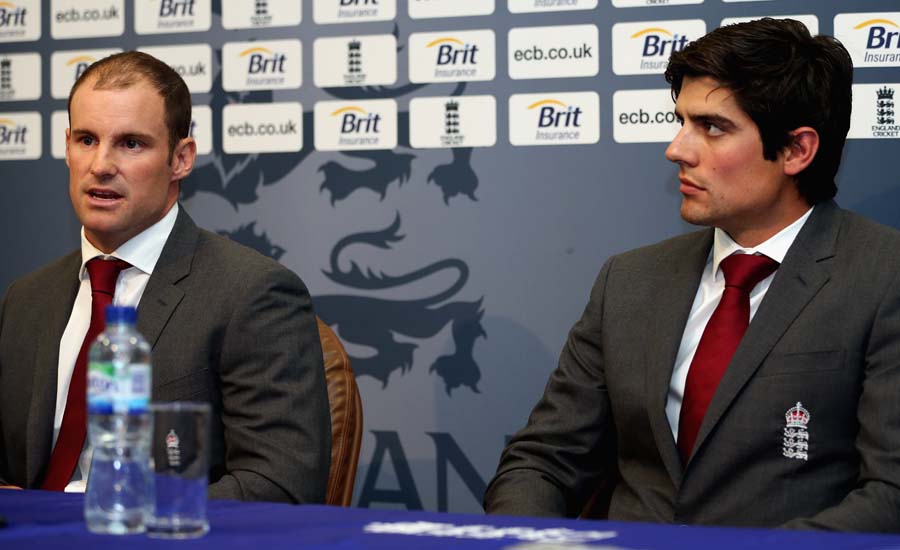
Changing of the guard…Strauss and Cook at the press conference.
As always, Strauss was highly dignified in his exit, putting the needs of the team first, as he has done his whole career.
He added: “I am extremely proud of everything I have achieved as a cricketer and I have found myself very fortunate to play in an era when some of English cricket’s greatest moments have occurred. I have loved every minute of it.”
With his retirement, Strauss ends a highly successful England career as both captain and batsman. Since his Test debut in 2004, he has gone on to play 100 Test matches, scoring 7037 runs at 40.91 including 21 centuries.
But it was perhaps his captaincy that will be most missed in the England dressing room. He took over the reins from Kevin Pietersen in early 2009, following turmoil in the dressing room after a public falling out between both Pietersen and then coach Peter Moores. In all he went on to captain his side in 50 matches winning 24 of those, whilst leading England to number one in the ICC Test rankings at the same time.
With retirement it ends a 15-year career in the game for the 35-year-old Strauss. He started out playing for both Durham University and Middlesex in 1997 before persistent run-scoring forced the selectors to pick him for an ODI series in Sri Lanka, in late 2003.
It wasn’t long before he soon forced his way into the Test side too. When making his debut in May 2004 at his home ground Lords, he scored 112 and 83. Since then, despite a brief spell out of the side in 2007, he has been an almost ever presence in one of English cricket’s most successful times in their history.
His most memorable moment will no doubt be leading his side to victory in Australia during the 2010/11 Ashes, where he became the first Englishman to win the urn on foreign soil since Mike Gatting in 1987.
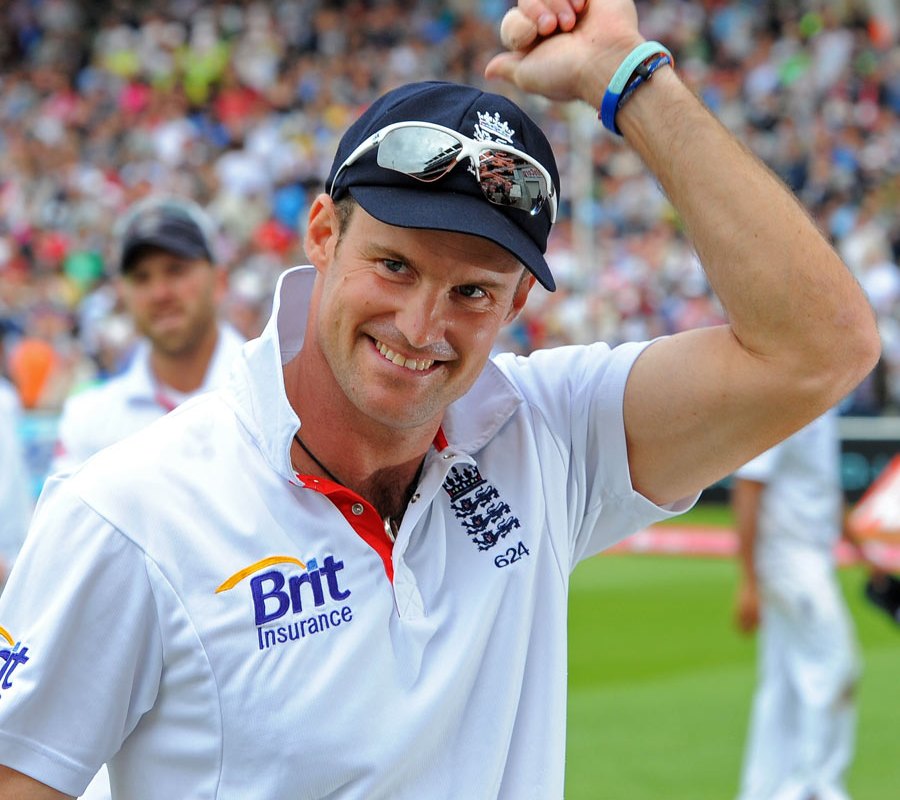
Strauss celebrates in 2011 after leading his side to number one in the Test rankings
The retirement and resignation of Strauss begins together a new dawn for English cricket. After losing their number one Test status to South Africa just nine days ago, they will hope Cook has what it takes to lead the side forward. His first assignment starts in India during the winter.
Cook has had enough experience of top level captaincy before. He took charge of the Test side in Bangladesh in 2010 when Strauss was being rested and went on to win the two-Test series 2-0, he has also been in charge of the ODI team since Strauss gave away the captaincy after the 2011 World Cup in India. Since the turn of the year, Cook has led England to eight victories out of nine in the shorter form of the game.
Cook was quick to praise his mentor and former captain Strauss, as he himself takes over the most coveted job in English cricket: “Andrew’s contribution to England cricket in recent years is evident to everyone who follows the sport but only those of us who have been lucky enough to share a dressing room with him are fully aware of his immense contribution to our success.”
The always calm and well-spoken Strauss leaves cricket behind only Michael Vaughan as England’s most successful captain of all time, and like Vaughan and Nasser Hussain previously, his captaincy falls victim to Graeme Smith and his touring South Africans.
Royals seal 10-run win despite Miller’s brilliance.
With 14 needed from the final over, Chris Wood kept his nerve to take three wickets and lead his side to their second Friends Life t20 trophy in three years.
Chasing 151 to win Yorkshire could only manage 140-8, despite a superb unbeaten 72 from David Miller which came off just 46 balls and included ten boundaries.
Miller along with Tim Bresnan had given Yorkshire a chance and with two overs left with the required run rate down to just over 10, Yorkshire were probably slight favourites.
But that all changed in the penultimate over as Dimitri Mascarenhas handed the ball to 21-year-old spinner Danny Briggs, who conceded just seven runs and kept Miller off strike for the final over.
When Wood had Bresnan caught with the first ball of the 20th over, the game was almost up and despite the batsmen crossing, Miller and Rich Pyrah could only take three singles off the next three deliveries before Wood finished things off by removing both Pyrah and Azeem Rafiq to start the celebrations.
The loss was tough on Miller, who after being Yorkshire’s top scorer in this year’s tournament with 390 runs at 48.75, looked for a stage like he was single-handedly going to win the white roses their first silverware in a decade.
After coming in with his side struggling at 3-38 following the dismissals of Andrew Gale (15), Joe Root (7) and Phil Jaques (11), Miller picked up where he had left off after his vital 47 in the semi-final and started strongly and hit a four off the fifth ball he faced.
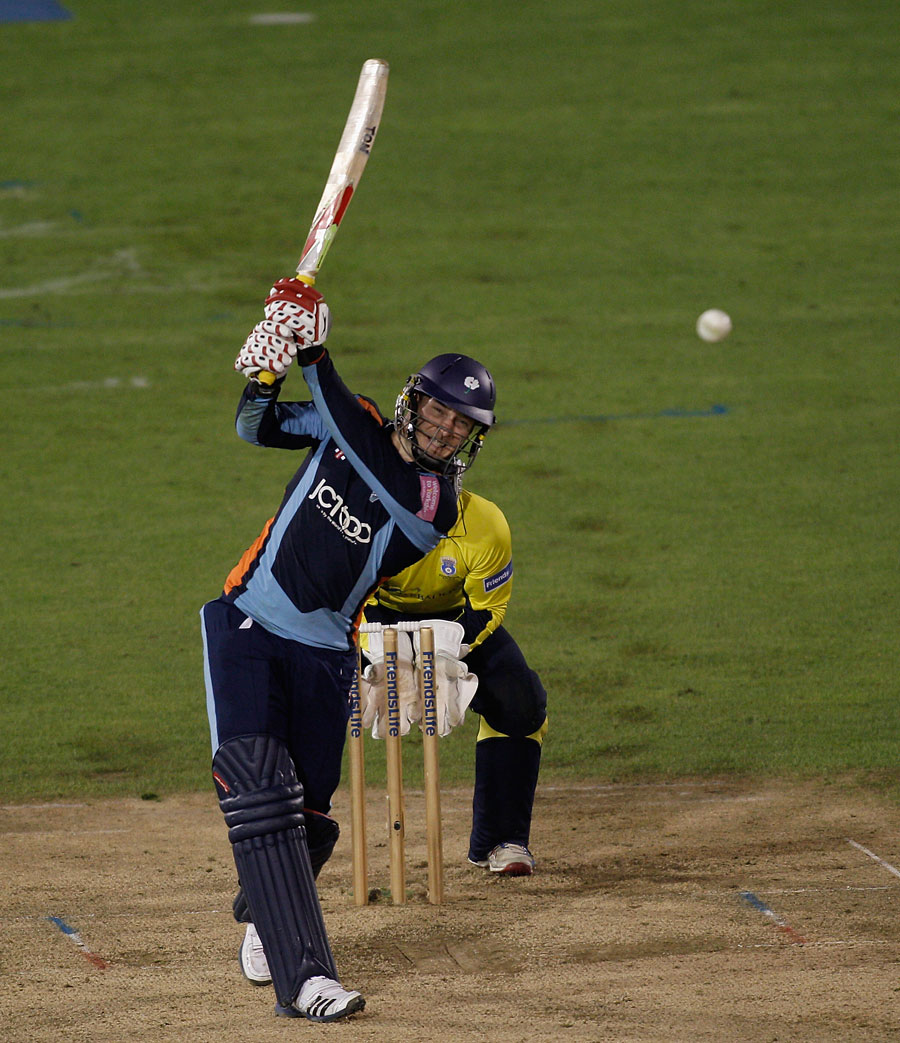
Lone Hand…Miller bludgeoned Yorkshire to within 10 of their target
With the loss of semi-final hero Jonny Bairstow (caught behind off Briggs for just 3) and with the run rate forever rising, a Yorkshire win was becoming even more unlikely with each delivery that went by, but with 98 still needed off the final 9 overs – Miller began his assault.
Joined by Gary Ballance, he added 40 for the fifth wicket with the highlight being the 12th over, where he hit Sean Ervine for three sixes in four balls to take 19 off the over and reduce the run rate to less than ten. Once Ballance had fell for a scratchy 7 0ff 16 balls the fight looked over but Miller kept his foot on the accelerator and nearly pulled off a one man great escape for Carnegie.
Earlier in the piece, Jimmy Adams (43) and James Vince (36) had given the Royals a great platform for a good score on a sluggish wicket, getting together to add 47 for the second wicket after Michael Carberry was bowled by Ryan Sidebottom for eight. Once Adams was dismissed by Pyrah, Neil McKenzie soon followed, struck in front by Rafiq for only four and a rebuilding job was again on hand as Vince and Ervine added a vital 37 before the former was bowled by Moin Ashraf.
With the match evenly poised at 113-4 after 16 overs, Hampshire needed to push on and did so with Simon Kaitch adding a quick fire 25 to go along with Ervine’s 21 and Liam Dawson’s 8.
In the end 150 looked a tough score to chase under pressure in a final and it eventually proved so, but if not for the efforts of Miller, Yorkshire wouldn’t have gotten close.
Sussex v Yorkshire: Earlier in the day, an unbeaten 45-ball 68 from England batsman Bairstow steered Yorkshire to a competitive 172-6 against Sussex, who in reply could only muster 136-8 despite the best efforts of Chris Nash, who lacked support during his 80 not out.
Winning the toss Yorkshire chose to bat in their first ever t20 finals day. But they soon found themselves in trouble as captain Gale holed out to mid-on for 11 to give Scott Styris the first of his three wickets in a tight spell of 4-1-22-3. Jaques was the next to go before the score had hit 20 as he missed a straight one from Styris for just 2, this was followed by the exit of Root who hit two fours before playing around another straight one from Styris to fall leg before for a disappointing 11.
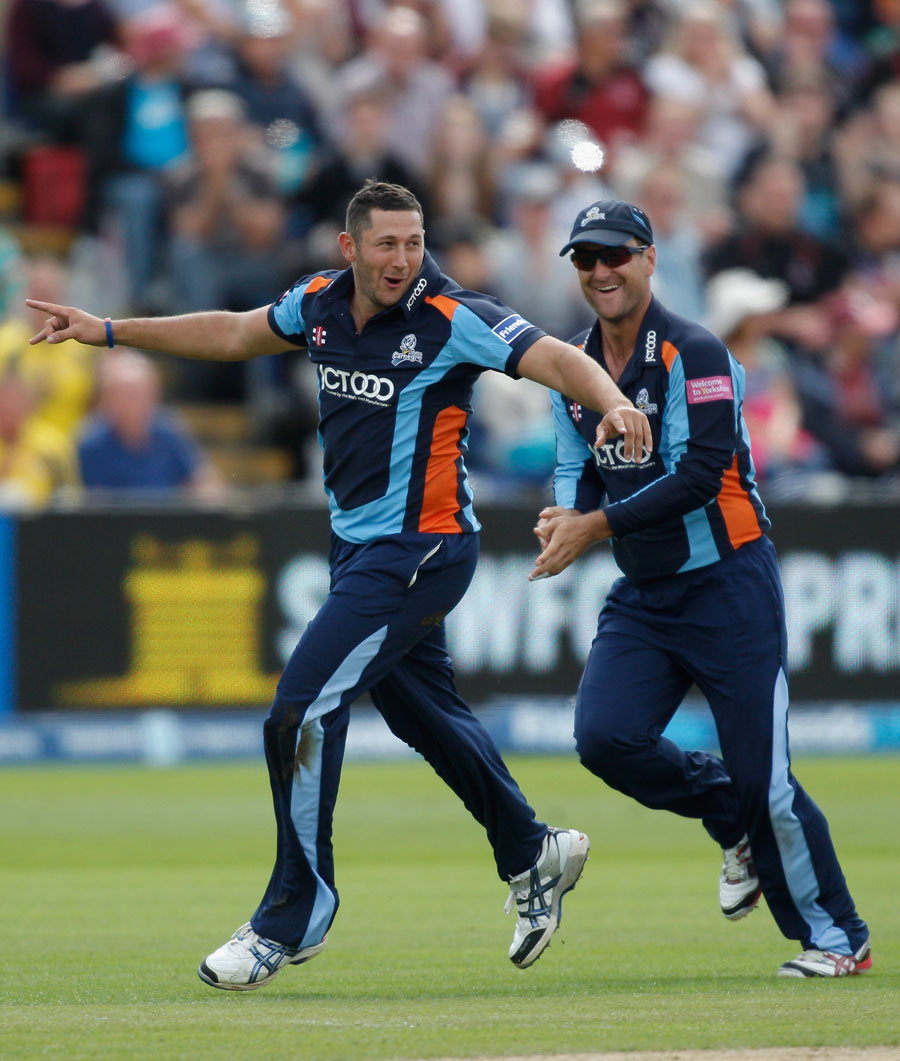
Tim Bresnan celebrates the key wicket of Matt Prior
With Yorkshire struggling at 3-36 after six overs, enter Miller and Bairstow, who after playing themselves in, began to hit boundaries at will during their 82-run partnership, which spanned 10-overs. Once Miller departed (caught in the deep off the bowling of Nash) for a momentum-building 47 from 35 deliveries, Bairstow continued his dominance with three 6’s to take the score past 150. Ballance and Bresnan came and went in quick succession, both falling to Chris Liddle but Bairstow was joined by Pyrah who helped see the innings past 170.
In reply it was vital Sussex didn’t lose early wickets, but they did. Both Luke Wright (3) and Matt Prior (2) were back in the hutch with just 15 on the board as Yorkshire sensed blood. Nash was then joined by the veteran Murray Goodwin and the pair added 40 for the third wicket before Goodwin picked out Ballance at long-on off the bowling of Pyrah for 15.
While Nash continued to score freely, his partners didn’t. First Joe Gatting was bowled by Pyrah for 3 before the dangerous Styris followed him, caught by Ballance off the bowling of Rafiq for 8 and the single figure scores didn’t stop there as Matt Machan (7) fell to Bresnan and Michael Yardy (2) and Will Beer (3) were both run out, leaving Nash stranded and Sussex 36 short.
Hampshire v Somerset: In the second semi-final, a vital partnership of 54 from Katich and Ervine saw Hampshire home as they chased down Somerset’s below par 125-6 with six wickets and an over to spare to book their place in the final and pour more heartache on the men from Taunton.
Batting first, Somerset regularly lost wickets as their line-up of star-studded hitters one by one found ways of gifting their wickets away against an effective and disciplined Royals attack.
Only Craig Kieswetter, who batted throughout the innings for his unbeaten 63, resisted. First to fall was powerful South African Richard Levi, who could only manage a single before he chipped the excellent Mascarenhas (4-0-11-2) to Katich at mid-on. Mascarenhas soon claimed his second victim as former England servant Marcus Trescothick, who had just hit a four and six, chopped on for a disappointing 12.
James Hildreth soon followed his captain to the pavilion as he was bowled behind his legs in Briggs first over. Jos Buttler was next in to join Kieswetter and hit two boundaries before becoming Ervine’s first scalp, bowled for 16. Just two overs later and Peter Trego (1) was pinned in front to become Ervine’s second wicket. Lewis Gregory (9) soon came and went, run out by Adams attempting a nonexistent second, leaving his side 90-6 with four overs remaining.
Arul Suppiah scored a quick-fire 12 and Kieswetter added 17 more to add some late runs to the innings, but in reality 125 was never going to be enough.
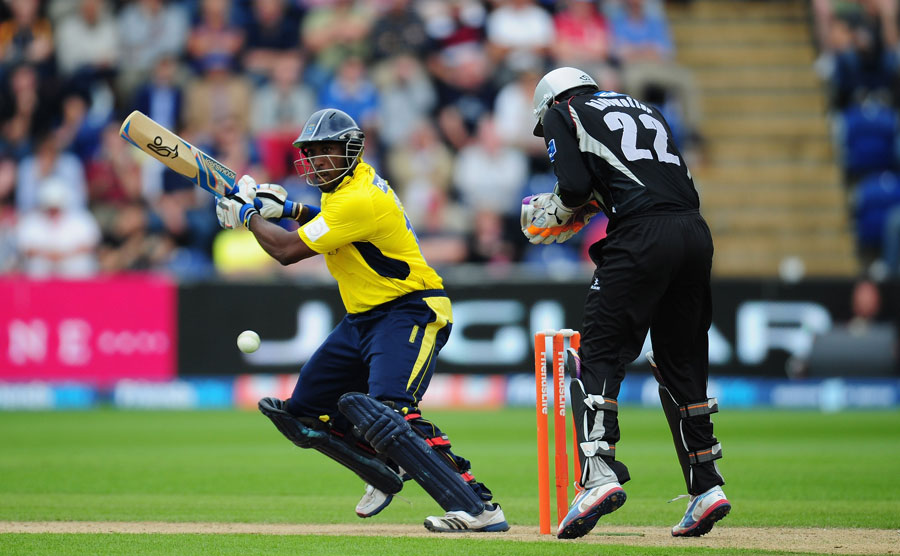
Michael Carberry made an aggressive start in Hampshire’s pursuit of 126
Carberry got his side off to a flying start in their reply, hitting Alfonso Thomas for three fours in his first over. Carberry continued to hog the strike ahead of Adams, but it was Adams (9) who fell first, smashing Steve Kirby to midwicket where Buttler took an outstanding catch. Carberry and Vince then looked to consolidate by knocking around the ones and twos whilst still keeping up with the required run rate and they appeared to be in no trouble until Vince (7) was bowled playing across the line in legspinner Max Waller’s first over.
Carberry was then joined by McKenzie and the partnership had barely began before a mix up ended Carberry’s stay at the crease, ran out for a promising 33.McKenzie (10) added 20 with fellow veteran Katich before falling lbw to Gregory, who bowled well in his two overs.
The experienced Katich then played a calm hand alongside Ervine, with both men looking to put away the bad ball and work the others around – the run rate never raised over eight.
The deciding over in the chase was the 17th. Bowled by the experienced Thomas who was brought back into the attack to create some pressure, it went for 11 as Ervine hit two fours to shift the momentum totally in favour of the men in yellow.
The 18th over also went for 11 as Ervine helped himself to another eight runs before taking 10 off the penultimate over as he finished unbeaten on 34 alongside Katich on 32, the rest as they say, is history.
After his unbeaten 119 for India on the first day of their Test series with New Zealand, is Cheteshwar Pujara, so long touted as “the new Dravid”, finally coming of age?
Returning to the Test side after 20 months away, the composed number three hit 15 fours and one six in 226 deliveries, to leave his side well poised on 307-5 overnight.
Playing in just his fourth Test match and first since the retirement of the Indian great Rahul Dravid, Pujara played with elegance and grit to grind down the Kiwi bowlers and finish the day unbeaten.
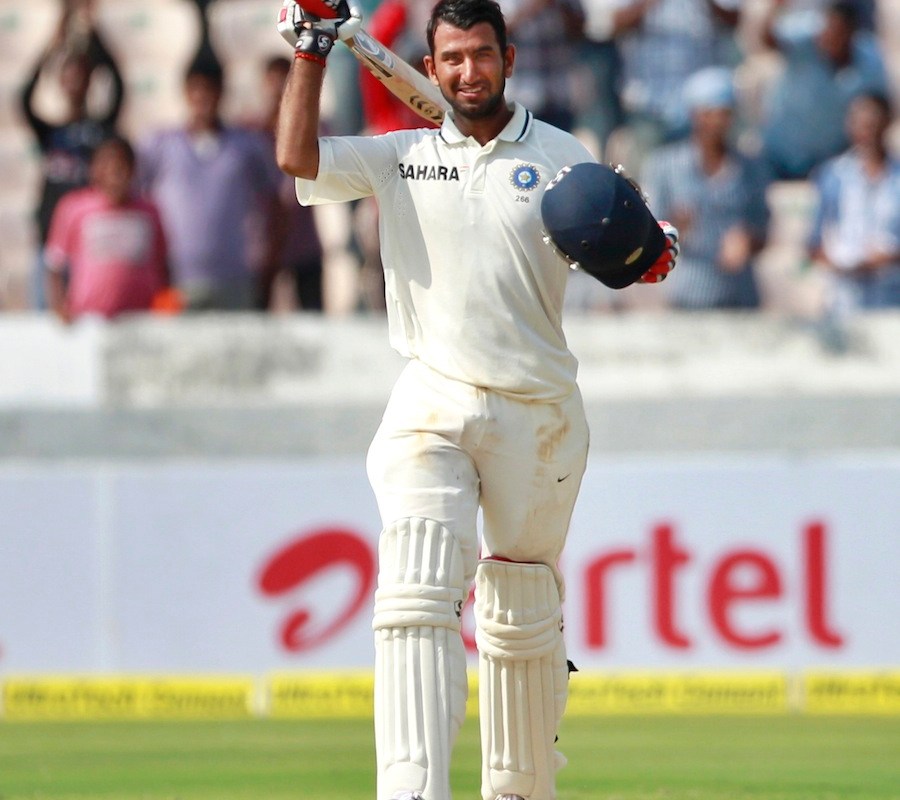
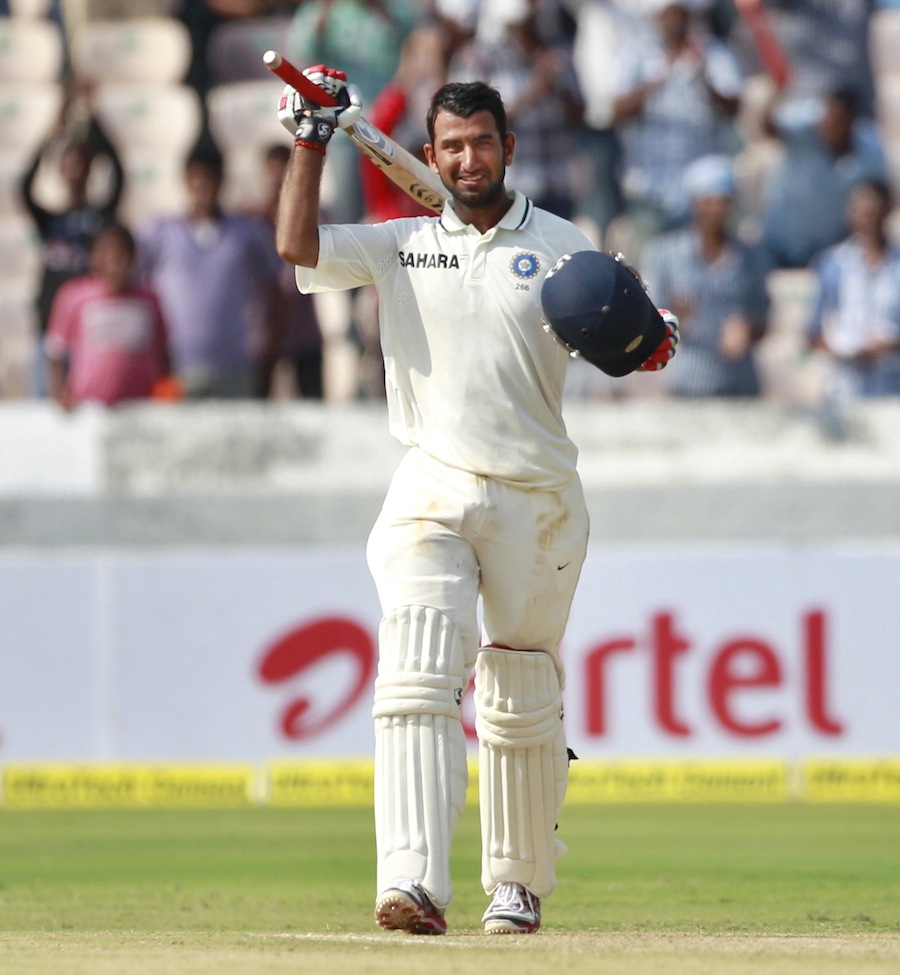
Pujara celebrates his maiden Test hundred
Coming in at 49-1, following the fall of Gautam Gambhir, Pujara didn’t look back as his partners came and went during his 77-over vigil at the crease. He stared in partnerships of 28, 48, 125, 10 and an unbeaten 47 with captain M.S Dhoni, as he composed his maiden Test hundred. After scoring an impressive 72 in Bangalore on his debut against Australia back in late 2010, he has played just two further Test matches since, both away in South Africa in early 2011. Whilst batting at number six, he struggled for the big scores he was renowned for at first-class level.
After the series in South Africa, Pujara was dropped from the Test side for the tour of the West Indies and replaced at six by Suresh Raina. Then the slide in Indian Cricket arrived. After their World Cup victory on home soil, they went into their tour of England as number one Test team in the world, but since there has been a huge decline. Eight consecutive away Test matches were lost and with the team’s failures came the retirements. Rahul Dravid went first and was closely followed by VVS Laxman, with both opening up spots in the Indian middle-order, which was once a closed shop.
And then we get back to Pujara, who has spent the last 20 months biding his time and waiting for his second opportunity. This followed a serious knee injury in which surgery was required. He was kept out of action for six months. Always one with an appetite for ‘big runs’, Pujara went back to his state side Saurashtra and although he disappointed scoring just 200 runs in this year’s Ranji Trophy, he did impress for the Indian A side on their tour of the West Indies in June, scoring three half-centuries in his six first-class innings on the trip. He was again firmly back in the selectors’ plans.
What a comeback it has been. Pujara, who once scored a triple-century at Under-14 level, certainly hasn’t disappointed at Hyderabad during his return to the side. During his unbeaten 119, he gave just one half chance, when on 60, he hit Jeetan Patel towards Daniel Flynn at short-leg, who put down a tough catch.
With the hard work done, Pujara must now come back tomorrow, start again and turn his hundred into a statement to the selectors, “I’m here to stay.”



 CaughtOutCricket