Why Australia picked the right Ashes squad

Cricket Australia logoSo the Ashes are just eleven weeks away. Gee, how quickly has time passed since Chris Tremlett bowled Michael Beer to regain the urn for England in January 2011?

Since then, England became the number one Test side in the world – then lost it to South Africa nearly a year ago, while Australia had a chance themselves to be that number one side, only for the South African’s to beat them at home last winter.

England will rightly go into this summer’s showdown as favourites, but with the squad the Australian’s have assembled – they have at least gave themselves a chance of pulling off what would be described as an upset.

After the recent Indian nightmare, the Ashes squad selection was an important one for John Inverarity and his selection panel after so many muddled mistakes were made in selection for that tour of India.

It’s not often in recent times that you can say the selections of a certain Inverarity look correct and well thought out, but on this occasion it looks like Australia have picked the best possible squad they could have named in the current circumstances.

The squad for the Indian series looked unbalanced and underwhelming at first glance and the 4-0 score line suggests it was just that.

The selections of the likes of Glenn Maxwell and Moises Henriques for the tour to India were baffling to say the least. Maxwell started the series as a spin-bowling allrounder and ended it opening the batting (The fact he bats at eight for Victoria – says everything you need to know!)

This new squad is different though. Players were picked on form and not just potential or ODI potential in Maxwell’s case. The squad is solid and balanced, with both youth and experience included in equal measure.

Unlike the squad for India, it doesn’t include ‘Bits and Pieces’ players like Henriques, Maxwell and Steven Smith. They have named the best possible batsmen, bowlers and wicketkeepers that the country has to offer.

Chris Rogers is one example of this new thinking. Its five years since Rogers made his one and only Test appearance – He has since been forgotten and shoved aside as younger men such as Phillip Hughes were given opportunities ahead of him – with the Australian selection panel looking towards youth in their rebuilding process.

Rogers could be forgiven for thinking his chance of adding to his solitary Test cap had gone but in the current climate where quality young Australian batsmen no longer grow on trees – 19,107 first-class runs at 50.01 simply couldn’t be ignored any longer.

Chris Rogers has scored 9,375 first-class runs at an average of 54.19 in English conditions.

Adding experience and leadership was a must for the Ashes campaign. Gone are Michael Hussey and Ricky Ponting – A combination of 247 Tests and 19,613 runs worth of experience to replace between them. That’s where the return of Brad Haddin as both keeper and vice-captain becomes invaluable.

Haddin was unfortunate to be dropped from the Test side in the first place and his return will be welcomed by everyone and especially captain Michael Clarke. The team will look towards his leadership and experience in English conditions to guide them through the tough times that an Ashes series throws up.

The batting order is something that needed sorting out in the post-mortem of the Indian tour and by picking the experience of Haddin and Rogers this can only help but solidify the top and middle order.

Other batsmen murmured in the media for a place in the squad include: George Bailey, Shaun Marsh, Adam Voges and Smith – but neither has any recent first-class form behind them excluding Smith – who has struggled on each of his trips to the UK.

It has to be said that both Hughes and Shane Watson are on borrowed time after difficult tours of India. That said both players – if on-form remain the best options the country has to offer in English conditions.

The bowling remains strong and the decision to recall the veteran Ryan Harris is a wise one. Despite his current injury woes, Harris on his day has the ability to rip through sides with his combination of good pace and late movement both ways.

Jackson Bird’s inclusion was also a must. A man whose bowling looks tailor made for English conditions, he will provide Clarke with a different option to the other bowlers in the squad. His 11 wickets at 16.18 in two matches against Sri Lanka last winter show he doesn’t look out of his depth at Test level.

The selections of Peter Siddle, James Pattinson and Mitchell Starc are no-brainers on recent showings, but it’s the decision to call up uncapped bowling allrounder James Faulkner that has many people excited.

The 22-year-old has excelled in recent seasons for Tasmania, winning their player of the year award for the last three seasons. First-class averages of 29 with the bat and 22 with the ball – suggest he can challenge Watson for the allrounder’s spot in the team and with age on his side he still has time to improve his all round game.

The quick bowling selections could be been far worse; Mitchell Johnson could have been included. The erratic left-armer has had his chances in the side and now must move aside to let Starc develop his game further.

Although an enigma on the cricket field, it is of my opinion that Johnson should never represent Australia in another Test match as there are now far better other bowling options available.

How much the Barmy Army would have loved to see him back in the Aussie line-up at Trent Bridge?

He bowls to the left, he bowls to the right…etc etc!

That’s my point though…Australia must provide a squad of players that get their English counterparts uncomfortable – By naming this set of players, they are doing just that.

Nathan Lyon is right now (Fawad Ahmed passport permitting) the best slow bowler in Australia and by naming just one spinner in the squad the selectors will have ensured Lyon with the confidence that he didn’t receive with his dropping for the second Test in India.
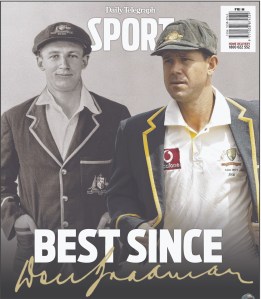
Yes, it can be said that this is a squad for ‘The here and now’ but it’s the Ashes for Christ sake! How many series can you afford to lose by blooding younger players who are either not good enough or not yet ready for the rigours of international cricket?

The rebuilding process can only go on for so long, especially seeming as the problems lay with the lack of batsmen being developed at youth level – problems that can’t be fixed overnight.

Praise must be given to the Australian selectors for their sensible selections in an age where expensive luxuries such as Maxwell and Henriques are forever being given chances in the side.

It’s hard to imagine that it’s the same selection panel that decided on Maxwell as a spin bowler for an Indian tour and one that selected Rob Quiney for a Test series against South Africa in November.

It may be that Australia will still lose the Ashes, but at least the selectors can hold their heads up high with the knowledge that they have picked the best possible squad at their disposal.

Ashes squad: 

Michael Clarke (capt), Brad Haddin (vice-capt, wk), David Warner, Ed Cowan, Phillip Hughes, Shane Watson, Usman Khawaja, Chris Rogers, Matthew Wade (wk), James Faulkner, Ryan Harris, Peter Siddle, James Pattinson, Mitchell Starc, Nathan Lyon, Jackson Bird.

My Ashes XI for the first Test at Trent Bridge:

  1. Ed Cowan
  2. Shane Watson
  3. Chris Rogers
  4. Michael Clarke
  5. Usman Khawaja
  6. David Warner
  7. Brad Haddin
  8. James Pattinson
  9. Peter Siddle
  10. Mitchell Starc
  11. Nathan Lyon
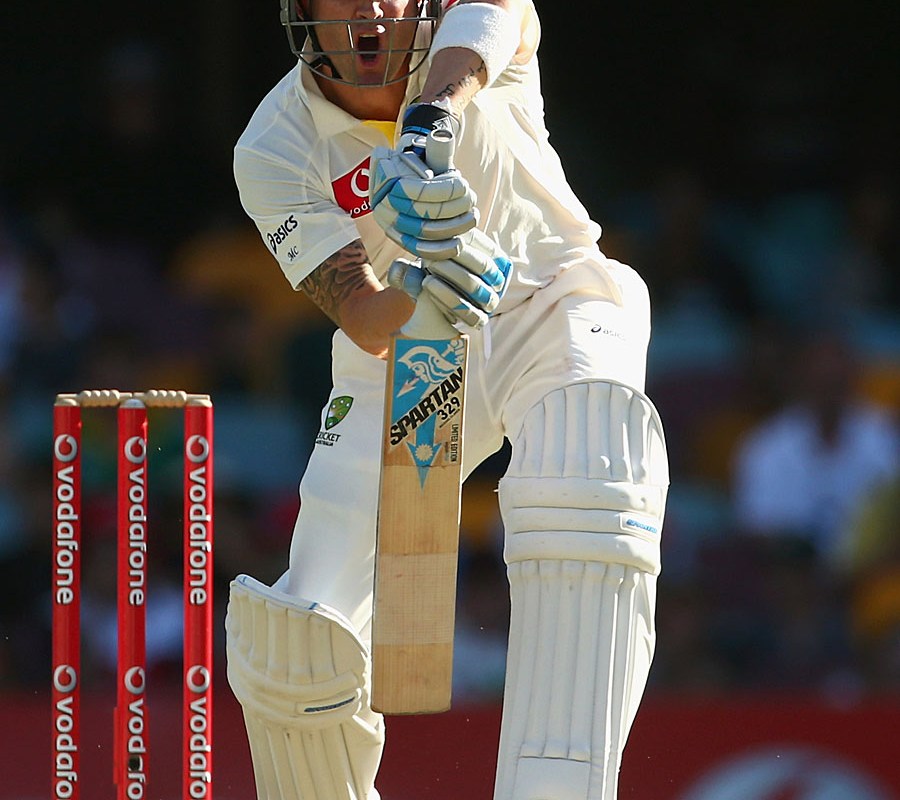
Can Ashraful become first Bangladeshi to score 200?

Over four years have passed since Mohammad Ashraful last scored a Test hundred for Bangladesh, now only eleven runs separate him from becoming his country’s first double centurion.

His unbeaten 189 in the ongoing Test in Galle has already succeeded his and his country’s previous highest score in Test cricket, an unbeaten 158 against India in 2004 and Ashraful will hope this is the turning point in a career that has promised so much, but delivered so little.

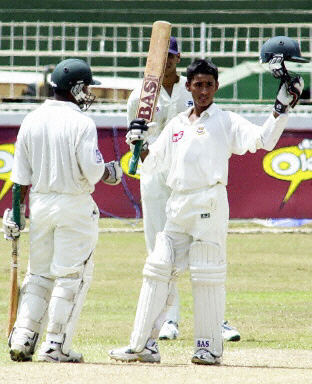
Roar of delight...Ashraful celebrates his first Test century since 2008.
Roar of delight…Ashraful celebrates his first Test century since 2008.

In many ways Ashraful’s career has mirrored that of his country’s since they gained Test status in 2000. He has promised many false dawns’s only to disappoint in the majority. A Test average of 22.60 goes nowhere near describing the talents of the man’s batting ability. The highlights have so often been followed by droughts that can rival those of the Sahara desert in dry season.

Those highlights started with a debut 114 against Sri Lanka, aged just 16 and have continued over the years with important ODI knocks against Australia (100, in Cardiff, 2005) and South Africa (87, in the 2007 World Cup).

His form in the recent past has been horrendous and the Bangladeshi selectors have given him as many chances as they possibly could in hope he would regain his top form.

Since his last Test hundred in late 2008, he has scored just one fifty and finally paid the price for such shortcomings after scoring just one run in his two innings against Pakistan in December 2011.

His domestic form this season has been steady and nothing more and the fact he was selected for this tour was in hope more than expectation. By no means was he a banker for a place in the first Test match – but a fluent 102 in Bangladesh’s only warm up match convinced the selectors to throw him back into the side.

On Sunday things looked different. This was a new Ashraful, a more disciplined batsman, perhaps sensing that this was really his final tilt at a Test career his talent warrants.

When he walked off the field after 398 balls and eight hours, he knew that he was just eleven runs shy of becoming his country’s first double centurion and whilst doing so putting his side in a position where it is unlikely they will lose the match.

What has been the most impressive part of his innings has been his ability to be more selective in what shots to defend or attack, the Ashraful of old simply tried to hit everything he wished, often leading to his downfall early in his innings.

A 16-year-old Ashraful after scoring 114 on Test Debut in 2001.

Coming to the crease on Saturday afternoon after his side had slipped to 1-23 in reply to Sri Lanka’s huge first innings of 4-570. He started in positive fashion and added 42 with Anamul Haque, before the opener gifted his wicket to Ajantha Mendes. Then came the innings defining partnership of 105 with debutant Mominul Haque, who himself impressed with 55.

When Haque was dismissed by Nuwan Kulasekara and Mahmudullah decided to walk past a Rangana Herath delivery without scoring, Bangladesh were a long way from even passing the follow on and another innings defeat looked likely.

That was until Ashraful was joined by his captain Mushfiqur Rahim. The pair blunted the Sri Lankan attack and with doing so claimed another national record with an unbroken partnership of 261.

A drive down the ground off Herath brought up Ashraful’s sixth Test century and with it a roar of delight, a removal of his cap and a kiss of the pitch. A weight had been lifted, but the work had only just started.

It is easy to forget that Ashraful is only still 28, his career has spanned over twelve years and 58 Test matches and despite the false dawns his career has never really taken off.

Despite now been behind the likes of Tamim Iqbal and Shakib Al Hasan in the country’s list of superstars, Ashraful remains the fans golden child of Bangladeshi cricket, perhaps the most talented batsman the Tigers have ever produced, maybe now he is finally realising that talent.

In a modern world where T20 cricket is taking over, Test cricket could do with a competitive Bangladesh and for the Tigers to be competitive, they need Ashraful to finally acknowledge his ability with bat in hand.

Dhoni steals Tendulkar’s thunder

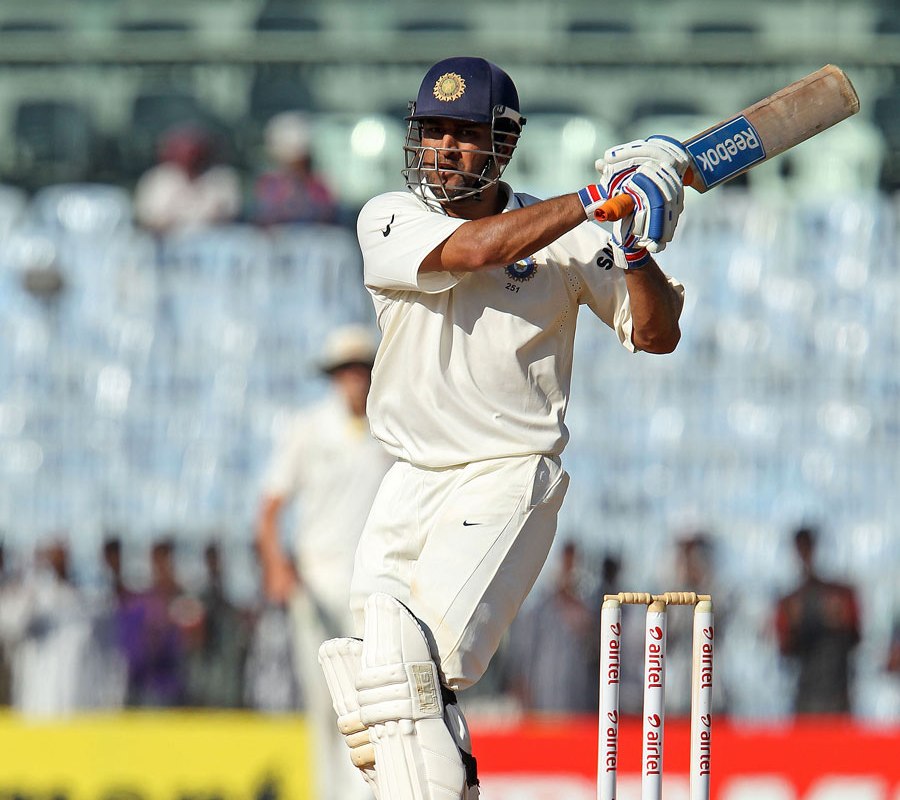
On a morning where thousands of Indian’s snaked around the MA Chidambaram Stadium in hope of capturing a glimpse of their hero Sachin Tendulkar’s 52nd and possible final Test century, it was instead the country’s other icon MS Dhoni who stole the show with an unbeaten 206.

Many fans queued as early as 5am in a country where Test cricket is supposedly dead as the godly like figure that is Tendulkar started the day on unbeaten on 71.

Leading from the front...MS Dhoni on his way to an unbeaten 206.
Leading from the front…MS Dhoni on his way to an unbeaten 206.

If everything was to go according to plan then the full house would witness Tendulkar define both age and critics alike and race to his 52nd Test hundred, but the beauty of cricket is that it often doesn’t go seldom to plan.

When the Australians kept Tendulkar and his batting partner Virat Kohli quiet for the first hour of play, the match turned on its head. Having battled his way to a further ten runs, the ‘Little Master’ copped a sharp turning offie from Nathan Lyon, a ball that he could only edge onto his leg stump. The stadium went quiet and Tendulkar’s vigil was over.  The match was evenly poised, but what would keep the passionate Indian fans engrossed for the remainder of the day’s play….Enter captain Dhoni.

Despite scoring 99 in his last Test innings, Dhoni was a man under pressure. The captain of the world’s most supported cricket team, the man who led his side to 4-0 defeats in recent overseas ventures of England and Australia and the man who led his side to their first home series defeat in eight years as recently as two months ago.

Many have called for Dhoni’s head as captain of the Test side in recent times. How can a man who’s regarded as one of the world’s best ODI captains and batsmen, not transform that into the Test arena?

India’s Test successes over the past two years have gone as far as home wins over the world’s seven and eighth best sides in the form of the West Indies and New Zealand. Much more is expected of a country with the cricketing history of India’s and today Dhoni’s broad bat showed his country that light is at the end of the dark tunnel that is Test cricket.

With the uneasy silence that the fall of Tendulkar’s wicket had brought around the ground, out stepped to the crease the day’s unexpected hero.

His first boundary didn’t arrive until his 22nd delivery, but by that stage Dhoni already looked assured at the crease and what was to follow would leave only one name on the lips of the devoted Tendulkar fans.

Three boundaries came off one Mitchell Starc over that took him past fifty and Moises Henriques was welcomed back into the attack with a sweetly driven six over extra cover, Dhoni had moved up a gear.

A missed run-out opportunity by Philip Hughes while on 88 wasn’t going to ruin Dhoni’s concentration, in fact it probably improved it as he took stock and buckled down, not reaching his hundred for a further nine overs.

After reaching his hundred, he wasn’t about to give it away. The overs slipped by and the occasional boundary came and went until Lyon was carted for two sixes in the 131 over of the innings, by this stage Dhoni had already passed 150 and was focusing on bringing up his maiden Test double.
The double was duly brought up with three overs of the day’s play to spare and Dhoni had lead his side to a lead of 135 and an un-losable position in the match.

The doubters were answered and the Tendulkar-rite’s were converted.

Australia set to face battle of spin

When Australia begins their four match Test series in Chennai on Friday, one thing is for certain – they are set to face a huge battle against slow bowling.

The key battle of the series will be the Australian batsmen’s ability to play against what looks like is going to be a four-man Indian spin attack.

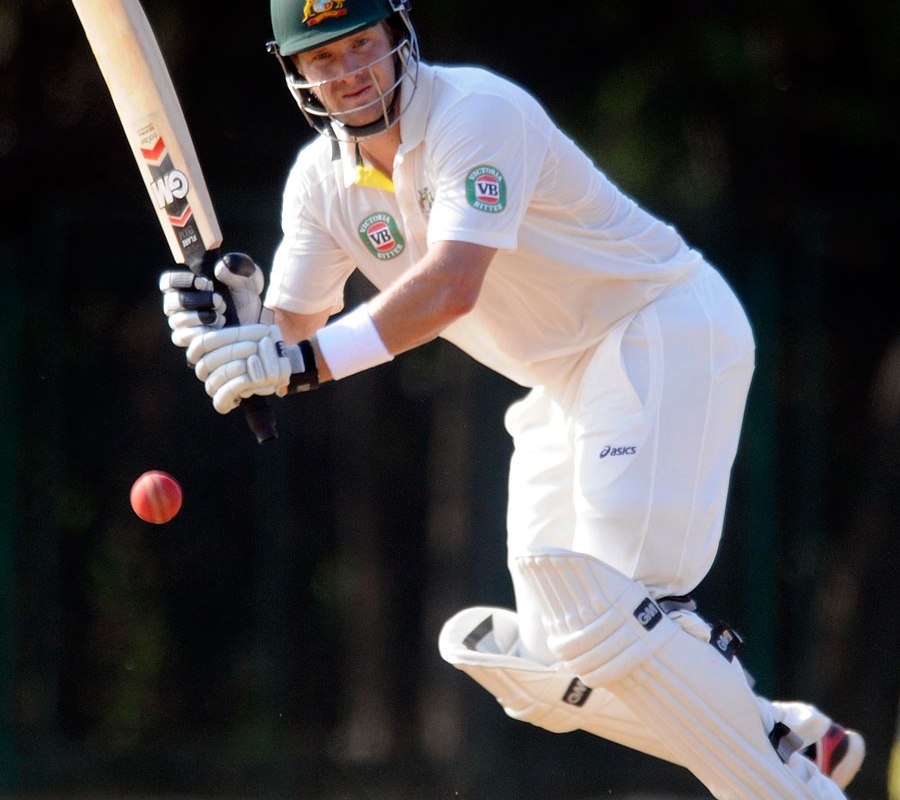
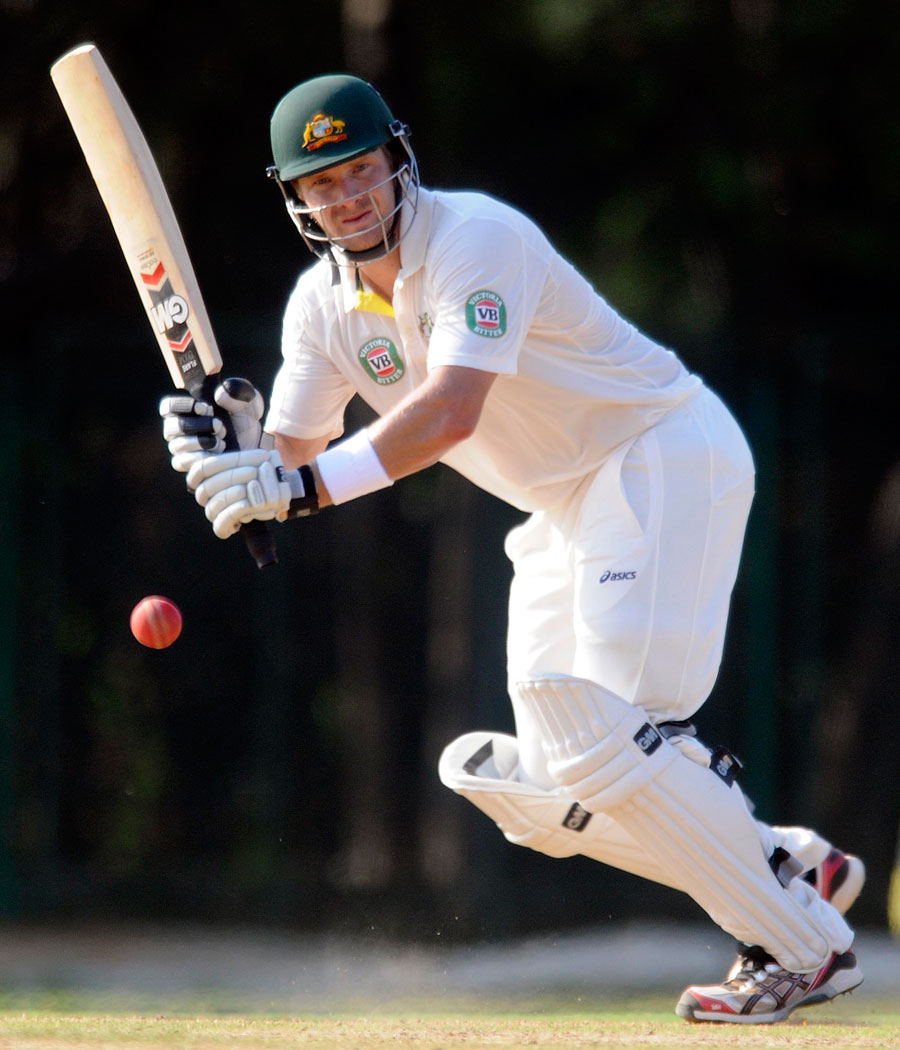
Shane Watson hits out during Australia's tour match against India A.
Shane Watson hits out during Australia’s tour match against India A.

If as predicted, then K Parthasarathy – the MA Chidambaram Stadium curator, will provide a turning wicket and the Indians will go in with three frontline spinners in Ravichandran AshwinHarbhajan Singh and Pragyan Ojha as well as the allrounder Ravindra Jadeja, who will bat at six.

Australia’s past record against quality spin bowling in less than desirable, especially when it comes to the current crop of batsmen – who apart from captain Michael Clarke, have lacked the application to grind it out against quality international spinners.

David Warner is expected to be passed fit to open the batting alongside Ed Cowan after a fractured thumb, meaning Shane Watson will have to settle for a middle order position at four.

After giving up bowling for the foreseeable future, Watson faces a big series in the Australian middle order. He has made no secret of his desire to bat at the top of the order and many Australian pundits have suggested that it should be him, not Cowan, opening the batting in Chennai.

After missing the final Test of the recent Sri Lankan series, the 31-year-old Queenslander, returned to make handy scores of 122 and 76 in the ODI series against the West Indies before top scoring in each innings with 84 and 60 at the top of the order in the second tour match against India A.

Since beginning his Test career in 2005, Watson has missed more Tests than he has played and his conversion rate of two hundreds to 19 fifties isn’t what it should be for a player of his calibre.

With Ricky Ponting and Mike Hussey now settling into life after retirement, Watson, alongside Clarke, suddenly becomes a key part of Australia’s brittle middle order. Without his bowling to fall back on, Watson must ensure he makes the most of his starts against the Indian spinners and goes on to score heavily whilst at the crease.

Australia’s middle order remains thin. Gone are the generation of run makers and for that matter the generation of back-up run makers – so often readily picked from Sheffield Shield cricket. Phillip HughesUsman Khawaja and Steven Smith have all been tried and ditched in Test cricket over the past four years and now the trio return looking to cement their places for what remains one of Australia’s toughest years in recent memory.

Only time will tell if it is a correct decision to select three allrounder’s (Smith, Glenn Maxwell and Moises Henriques) in the touring party and what looks like just one back up specialist batsman in Khawaja.

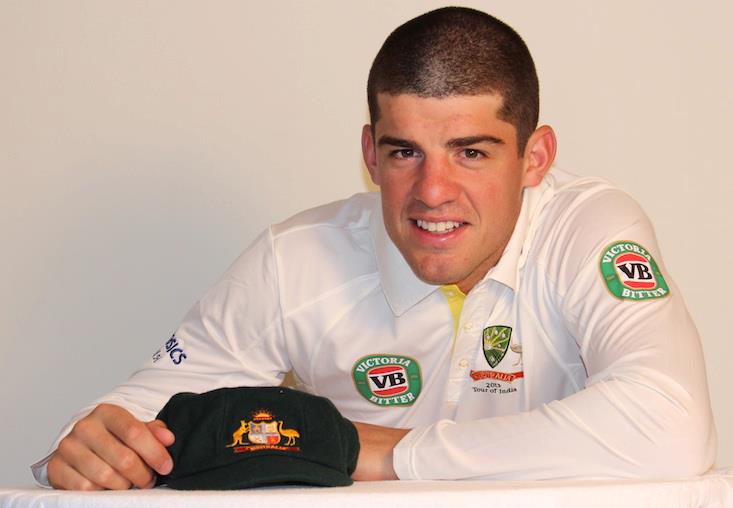
Moises Henriques is set to become Australia's 432nd Test cricketer.
Moises Henriques is set to become Australia’s 432nd Test cricketer.

I would have personally given a chance to Alex Doolan, who has impressed in Sheffield Shield and Australia A cricket this summer. Surely Doolan couldn’t do much worse than Smith as a batsman and the fact that Smith averages 73.33 with the ball in Test cricket – says all you need to know about his legspin bowling.

Another inclusion the selectors have missed out on is that of the former keeper Brad Haddin. After Clarke, Haddin remains the country’s best player of spin bowling and although the move to bring him in as a specialist batsman would be looked at by some as a backwards step with Haddin being 35, his experience and knowledge of the subcontinent pitches would be a valuable asset to this untried middle order.

As announced on Wednesday, Henriques will receive his baggy green, making him Australia’s 432nd Test cricketer. The Portuguese-born allrounder will bat at seven with Matthew Wade moving up to six, meaning the side will go in with four quicks (Peter SiddleJames PattinsonMitchell Starc and Henriques) alongside the lone spinner Nathan Lyon.

Coach Micky Arthur was impressed with the way Henriques performed in the two recent tour matches as he took 4-12 and 1-30 with the ball as well as scoring 16 and 33 with the bat. It was his lower order hitting that particularly impressed Arthur – as he hit three sixes and two fours in his 33 off 41 balls against India A. Although it was a short innings, he showed his prowess for attacking the spinners, a trait which his fellow teammates must follow in the coming weeks.

Judging by the performances of the Indian spinners in Australia’s two tour matches, facing slow bowling in the upcoming Test series is set to be a struggle for the tourists.

In their first match against the Board President’s XI, they were dismissed for 241 with little known off-spinner Parvez Rassol taking figures of 7-45.

They were also dismissed cheaply in their first innings in their encounter with the India A. Slow-left-armer Rakesh Dhurv and off-spinner Jalaj Saxena shared nine wickets between them as the visitors were shot out for just 235 in reply to India A’s 451. Made to follow on, they reached a relatively comfortable 195-3 in their second innings, largely thanks to an opening stand of 116 between Cowan and Watson.

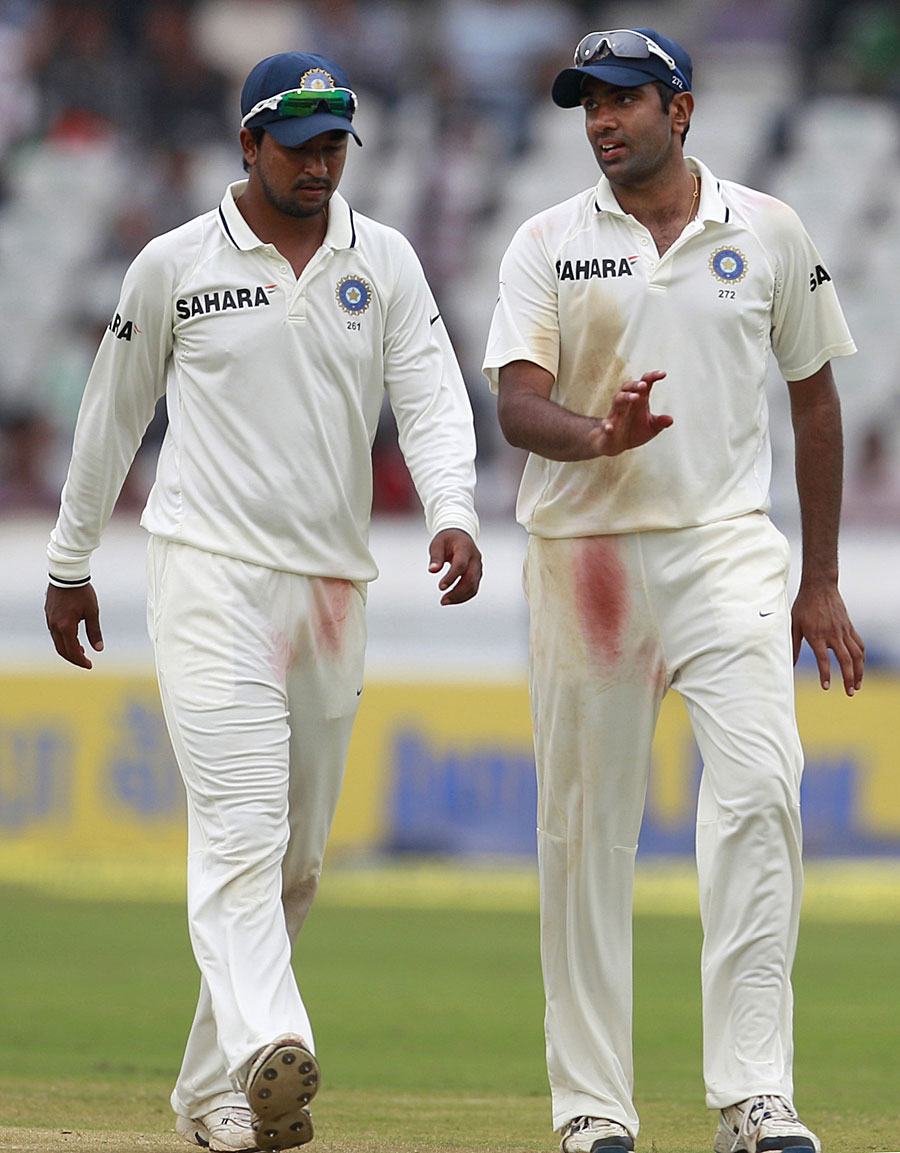
Spin twins...India's Pragyan Ojha and Ravi Ashwin.
Spin twins…India’s Pragyan Ojha and Ravi Ashwin.

Concerns certainly remain over the Australian batsmen in turning conditions – especially the way that Watson and Cowan played with uncertainly against the wily Rangana Herath in their recent home series with Sri Lanka, and that was in unhelpful spinning conditions.

The quartet of Ashwin, Harbhajan, Ojha and Jadeja may not be the potent a force of the famous Indian quartet of the 60’s and 70’s in Erapalli PrasannaBhagwath ChandrasekharSrinivas Venkataraghavan and Bishan Bedi, but they have the skills to worry the visitors nonetheless.

The Australians struggle against slow bowling has not gone unnoticed by the Indian’s and they can expect slow turning wickets to be produced for all four Tests.

When facing the spinners it will be important for the Australians to rotate the strike as often as possible and not just get struck between hitting boundaries and defending. With four left-handers in the top six, (Warner, Cowan, Hughes and Wade) the Indian off-spinners will fancy their chances of getting regular breakthroughs and getting into Henriques and the bowlers early on.

On the other hand the Aussies must take heart from the way that the English Batsmen (Alastair CookKevin Pietersen and Matt Prior) in particular played Ashwin and Ojha after their disastrous first innings decapitation in Ahmedabad.

Ojha finished the England series join wicket taker alongside Graeme Swann with 20 wickets at 30.85, while Ashwin was disappointing in taking 14 wickets at 52.64. Together the pair bowled the majority of India’s overs across the series with a combined 491.1 overs between them out of India’s total of 839.3 throughout the four Tests.

Harbhajan played only one Test of that series but has an excellent record at home against the Australians. He has taken 81 wickets at 24.48 in his 12 Tests to date, although his bunny Ponting is no longer in the Australian side and his effectiveness and confidence in the longer form of the game has also waned over the past couple of years as he has tended to operate more defensively.

The fact that Australia have averaged less than 32 with the bat in India since 1995 doesn’t bode well. They can though fall back on the knowledge that they are the last side before England to beat the Indians in a Test series on their own soil.

How will Australia replace Mr. Cricket?

When Cricket Australia announces their Test squad for their tour of India on Thursday, for the first time in 79 Tests it will not include the familiar name of Mike Hussey.

It has now been a month since Hussey decided to step away from the international spotlight, and the search for his predecessor is still no closer to its conclusion.

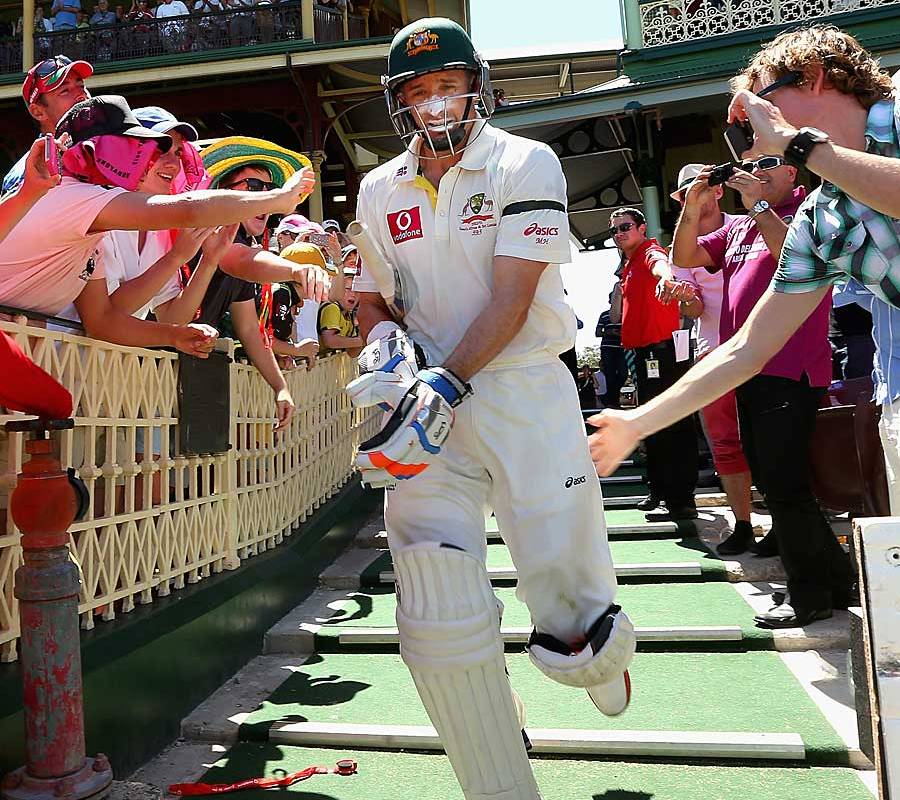
Sorely missed...Mike Hussey walk to the crease for the last time in Australian colours.
Sorely missed…Mike Hussey walks to the crease for the final time in Australian colours.

When Hussey announced his retirement from all forms of international cricket on Saturday 29th December, it came from nowhere. Typical of the man, he had wanted to announce his retirement on a quite note. He has after all gone about his career for Australia in a low key manner and with minimum fuss.

The day he announced his retirement, the cricketing public were mourning the loss of Channel 9 broadcaster Tony Greig and Hussey’s retirement took second fiddle.

He celebrated his final Test match against the Sri Lankan’s at the SCG with an unbeaten second innings contribution of 27, leading Australia home with a typically calm and efficient batting display.

Hussey’s decision to retire certainly came as an unwanted surprise to the Australian selectors – who would have thought that they would be able to rely on his availability until at least the end of 2013.

Australia’s 2013 schedule is no doubt their most challenging in recent years. A four-Test tour of India is followed by a summer in England, firstly with the Champions Trophy and secondly with a hugely important five-match Ashes series. Whilst the winter sees them host England in five more Ashes Test matches.

The year will be a test of both Australia’s physical and mental capabilities, without Hussey’s experience, their task becomes much more difficult.

With Ricky Ponting having also retired recently, the Aussie middle order is as thin as it has been since Allan Border’s side in the mid-eighties.

Hussey leaves the game with 6,235 runs at 51.52 with 19 Test hundreds to his name – certainly big shoes to fill, especially considering that in 2012 he averaged 59.86 with the bat, unlike Ponting, Hussey ended his career at the top of his game. He has left people asking: “Why did you retire” instead of “Why didn’t you retire.”

While Hussey leaves the game as a modern day great, the search for his replacement is a concern for the Australians especially with such a huge year ahead of them.

They must also decide whether they are going to continue with playing six frontline batsmen or if they are willing to push up Matthew Wade to bat in Hussey’s number six spot and pick an allrounder at number seven.

Another problem they have faced is the scheduling of the Australian summer. Until the past week, none of the potential replacements for Hussey have played any form of first-class cricket since the end of November as the Big Bash League took centre stage during the past two months.

With the tour of India coming up in the next month, the most first-class cricket any player will play will be limited to just a couple of matches. The timing of the ODI series with the West Indies also doesn’t help and word is that the Australians will pull out some of their players half way through that series so that they can prepare for the Indian series.

With Philip Hughes seemingly already having cemented his place as Ponting’s replacement for the near future, I look at Australia’s potential replacements for Hussey in the Test side.

Glenn Maxwell
Glenn Maxwell

Glenn Maxwell (24, Victoria) – The 24-year-old off-spinning allrounder was called into the Australian Test squad as cover for Shane Watson for the final Test of the recently concluded Sri Lankan series, but was over looked as the Aussies went in with a five-man bowling attack.

Maxwell has a career first-class average of 42 for Victoria but has struggled in his handful of opportunities in Sheffield Shield cricket this season averaging just over 30, doubts certainly remain over his abilities with the bat in the longer form of the game, one such problem arises with his State often batting him as low as number 8.

One thing that has kept the selectors keen is his so-called ‘X-factor’ – a trait which led to him winning both his ODI and T20I debuts in 2012 after fine form with Hampshire in the English T20 competition.

Maxwell’s batting remains fragile in first-class cricket, and his ability with the ball alone shouldn’t warrant him a place on the tour to India, where he could end up looking out of the depth as Cameron White did on Australia’s 2008 tour of India.

Usman Khawaja
Usman Khawaja

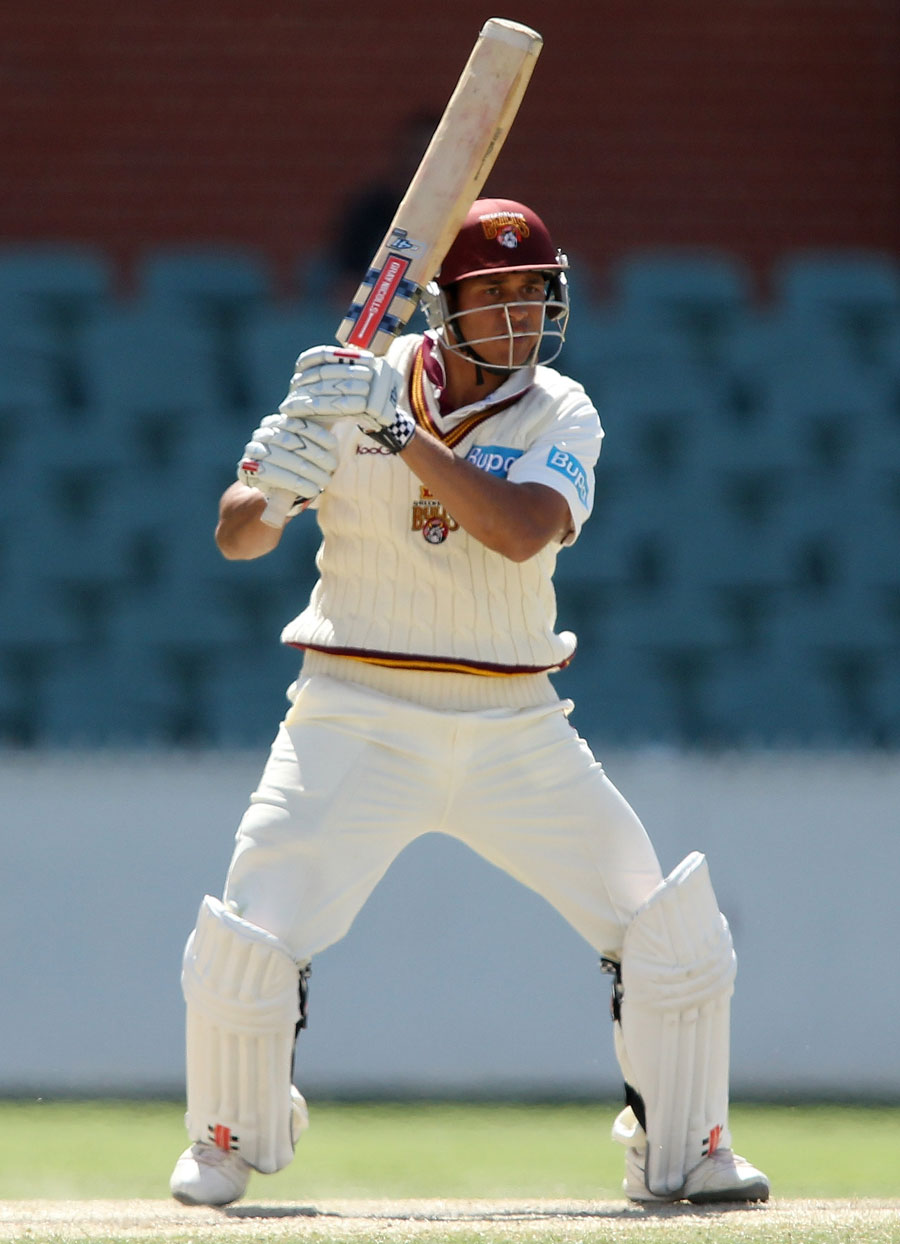
Usman Khawaja (26, Queensland) – Picked as many people’s favourite to fill the void left by Hussey, the Pakistani-born left-hander has already had a taste of Test cricket after making his debut in the final Ashes Test of the 10/11 series. A run of six Test matches during 2011 was followed with Khawaja being dropped after a poor series against New Zealand.

The disappointment of being dropped clearly hurt Khawaja and he made the decision to play county cricket for Derbyshire during the 2012 season. His returns for the East Midland’s side were solid if not spectacular and he still found himself looking in from the outside in terms of Test selection. But like Hughes he decided to leave New South Wales in search of better batting wickets and started the Shield season playing for Queensland.

The change of scenery has clearly had a positive effect on his game as he has racked up 438 runs at 39.81 in tough batting conditions, none more so than his superb 138 against Tasmania in Hobart, where no one else went past 49 in the match.

Doubts remain over his ability to rotate the strike often enough but it’s likely that Khawaja will see some playing time for Australia’s Test side over the course of the year. A big opportunity waits for him to improve on his substandard Test batting average of a touch under 30.

Alex Doolan
Alex Doolan

Alex Doolan (27, Tasmania) – Probably the most deserving batsman to replace Hussey after fine run of scores for both Tasmania and Australia A this season have led to ‘Dools’ scoring a superb 570 runs first-class from six matches at an average of 81.42.

This included an excellent unbeaten 161 against a touring South African attack that compromised of Dale Steyn, Vernon Philander and Imran Tahir. Despite his hundred against the Proteas, Doolan was over looked for the vacant number three Test spot in favour of Rob Quiney, who had scored 85 in the same innings.

Doolan has the experience of having played 37 first-class matches since his debut four years ago and also has the best recent Shield form of any of the candidates.

George Bailey
George Bailey

George Bailey (30, Tasmania) – Doolan’s state captain at Tasmania and Australia’s current T20 skipper, Bailey is on the selectors radar because of his strong leadership skills rather than his extraordinary first-class form.

After been named Australia’s T20 captain in 2011-12, despite not having played for his country in the format, his form over the past few years has been steady. To date he has averaged close to 40 in his 17 ODI’s and 29 in his 13 T20I’s, although his first-class form so far this season has been underwhelming with just 169 runs in six innings.

The selectors certainly like the look of what Bailey can offer in the shorter forms – But is his technique up to the spinning wickets of India or the green tops in England? A productive early season spell as captain of Hampshire could help his cause for Ashes selection.

Brad Haddin
Brad Haddin

Brad Haddin (35, New South Wales) – The veteran glovesman can certainly count himself unlucky to currently be out of the Australian Test set-up, but his leadership experience and 2012-13 form should ensure he makes the trips to India and England.

After scoring 2257 runs in 43 Tests as wicketkeeper between 2008-2012, Haddin relinquished the gloves to Matthew Wade after making himself unavailable for last year’s Test series of the West Indies. Such has been Wade’s form since then that the only way Haddin would secure a return to the side would be as a frontline batsman.

Given Haddin’s recent form in Shield cricket (6 innings, 337 runs at 67.40) and his standing as second only to Michael Clarke in his ability to play spin bowling, he should make the trip to India. Likewise with his experience of keeping in England and Wade’s lack of, he should make the tour as back-up keeper.

Joe Burns
Joe Burns

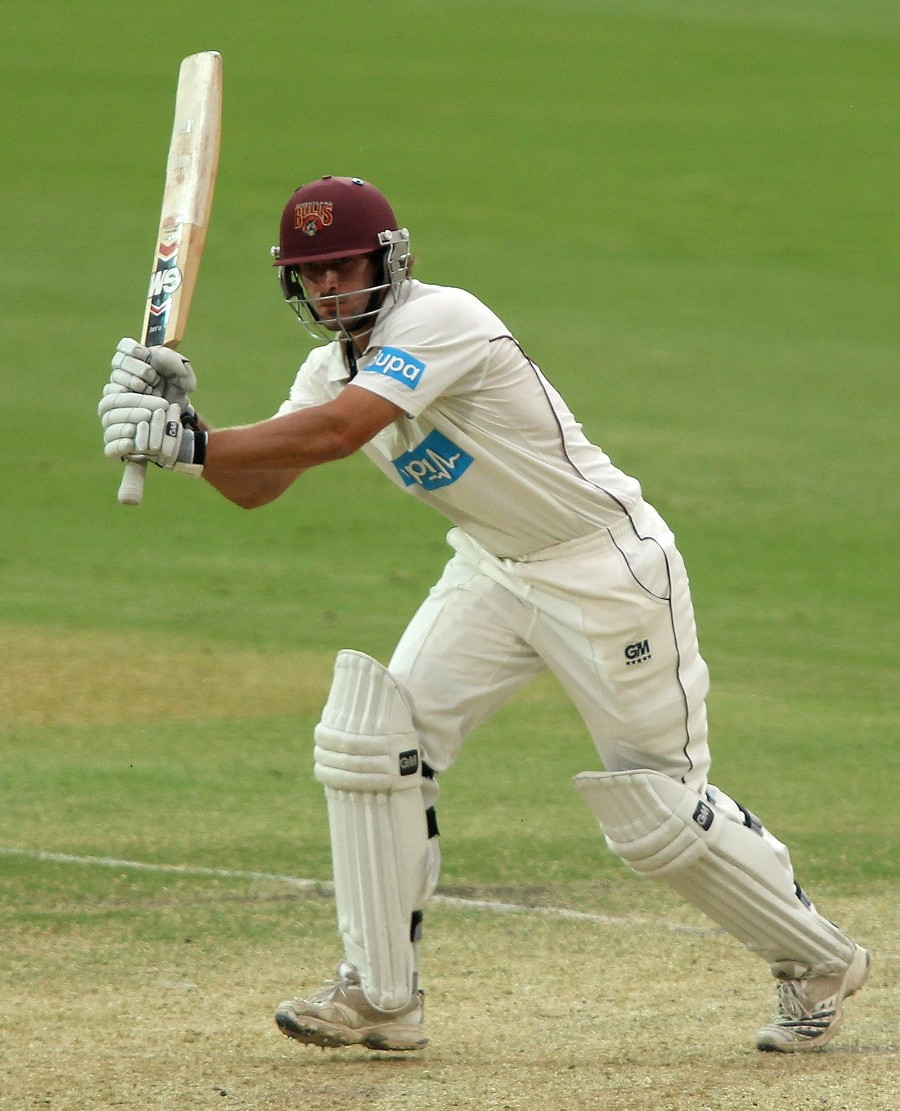
Joe Burns (23, Queensland) – A left field choice and the youngest of the potential Hussey replacements, the 23-year-old has enjoyed a fine season for the Brisbane Heat in the Big Bash, although he remains a work in progress in Shield cricket.

A confident striker of the ball, Burns only made his first-class debut two years ago but has since become a fixture in the Queensland top order as well as making his Australia A debut in England last June.

Although his Shield form this season has been disappointing, he has averaged just 30.50 compared with his career average of 42.28, he remains a talented cricketer and it’s surely only a matter of time before he is given his chance to impress on the International stage.

Steven Smith
Steven Smith

Steven Smith (23, New South Wales) – Like Burns, Smith is also just 23, but unlike the Queenslander, Smith has already had international experience with 33 ODI’s and five Tests to his name.

Smith made his Test debut almost three years ago against Pakistan in England after he was seen as a legspinning-allrounder, but has since played just five Tests and averages a less than appealing 28.77 with the bat and 73.33 with the ball.

His legspin has been shown up at Test level and the fact that he rarely gets the ball in Shield cricket suggests he is now seen as a batsman foremost.

He has certainly shown promise with the bat in recent years and reports are out that he is on the verge of selection for the Indian tour, this will more than likely be as a back-up batsmen though and not as a direct replacement for Hussey.

In eight innings for New South Wales this season he has scored 296 runs at 37. Despite his inability to turn starts into hundreds, he remains a player the selectors have invested a lot of time into and it won’t be long until they try and find a way to reintroduce him into the set-up.

With the Australian selectors set to name a 17-strong squad for the tour of India it remains to be seen as to who will step in and replace the dependable Hussey or if they will score heavily enough in India to book their place for the back-to-back Ashes series later in the year.


2012 – The Year That Was

Cricket Fireworks

In this post I look back at the major happenings in World Cricket over the past twelve months.

Test Cricket:

Number one ranked side England started the year with a humiliating 3-0 defeat against Pakistan in the UAE, as Saeed Ajmal (24 wickets) and Abdur Rehman (19) tormented their batting throughout the series.

Newly appointed captain Michael Clarke led Australia to a 4-0 home whitewash of India. Both he and Ricky Ponting helped themselves to double hundreds in the final Test in Adelaide, following on from Clarke’s triple hundred in Sydney.

Mystery Spinner? Saeed Ajmal ran England ragged as Pakistan whitewashed England 3-0 in the UAE.
Mystery Spinner? Saeed Ajmal ran the English batsmen ragged as Pakistan whitewashed England 3-0 in the UAE.

Less than a year after returning to the format, Zimbabwe suffered their worst ever Test loss with an innings and 301-run defeat in New Zealand.

South Africa returned home from a tour of New Zealand with a 1-0 victory in a 3-Test series, the highlight of the series was paceman Vernon Philander becoming the second fastest man to 50 Test wickets, he achieved the feat in just seven matches.

England’s failure to play decent spin bowling well was again shown up as Rangana Herath took 12 wickets, leading Sri Lanka to victory in the first Test. A superb 151 from Kevin Pietersen helped the visitors level the two-Test series with an 8-wicket win in the second match.

The West Indies showed gradual improvement on their form in the longest format, but started the year with a 2-0 home loss to Australia despite three close Test matches.

A weakened West Indies team suffered at the hands of England in their 3-match series, falling to five and eight-wicket defeats at Lords and Trent Bridge before a rain affected third Test was drawn, despite an extraordinary innings of 95 from Tino Best.

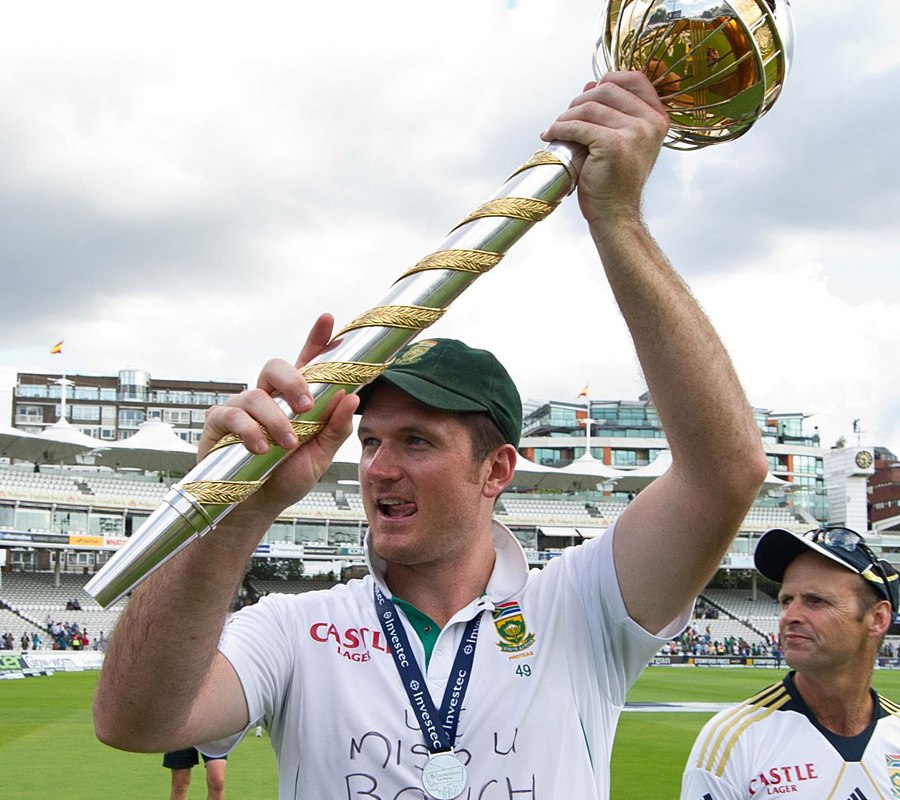
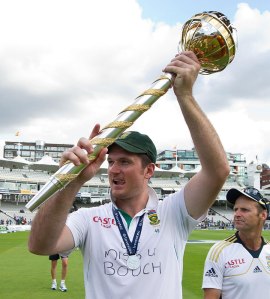
South African captain Graeme Smith holds the ICC Test Mace aloft after his side's victory over England.
South African captain Graeme Smith holds the ICC Test Mace aloft after his side’s victory over England.

Centuries from Tillakaratne Dilshan and Kumar Sangakkara led Sri Lanka to a 209-run win and a 1-0 series victory at home to Pakistan, the other two Tests ended in dull draws.

Chris Gayle marked his Test comeback for the West Indies with a century as his side beat New Zealand by 9-wickets in Antigua. Marlon Samuels then scored 123 and 52 in the second Test at Kingston to wrap up the series whitewash.

In what was billed as the unofficial Test Championship, England relinquished their number one ranking to South Africa with a 2-0 series loss. Hashim Amla was the pick of the batsmen at The Oval, smashing an unbeaten 311 as the Proteas recorded an innings and 12-run victory. Weather affected the second Test at Headingley leaving both teams to settle for a draw, before the South African’s gained the Test mace, they have long craved after, with a 51-run win at Lords in the third and final Test.  The series will also be remembered for the Kevin Pietersen debacle, which caused him to miss the third Test.

Cheteshwar Pujara’s first Test century led India to an innings and 115-run victory in their first home Test against New Zealand and they sealed the series win with a 5-wicket return in the second Test where Virat Kohli top scored in each innings with 103 and 51no.

Despite Sri Lanka’s Rangana Herath taking 20 in two Tests, New Zealand took a share of the spoils as the series ended 1-1. Sri Lanka eased to a 10-wicket win in the first Test only for the Black Caps to charge back in the second thanks to centuries from Ross Taylor and Kane Williamson and eight wickets from seamer Tim Southee.

South Africa somehow held onto their number 1 ranking with a 1-0 win in Australia despite been outplayed in the first two Tests of the series. Australia had the better of the first two Tests in Brisbane and Adelaide thanks to a pair of double hundreds from the ever more dependable Michael Clarke, but despite pushing for victories in both matches, the South Africa’s held on. But Like all true champions, Graeme Smith and his men roared back with a huge 309-run thrashing of the Aussies in Perth to take the series and hold on to the Test mace.

After playing well for a couple of sessions against the West Indies, Bangladesh finally folded on the fifth day to lose by 77-runs, Shivnarine Chanderpaul, still defying age at 38, was the mainstay of the West Indies batting effort with an unbeaten 203. The second Test was more of a one-sided occasion as the Windies dominated with a 10-wicket win, Marlon Samuels top scored with 260 and Tino Best finished off the Tigers with 6-40 leaving only a small chase to complete a series whitewash.

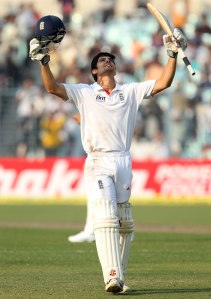
Captain Cook...Alastair Cook led from the front with three hundreds in his side's series win in India.
Captain Cook…Alastair Cook led from the front with three hundreds in his side’s series win in India.

England finished the year with an impressive 2-1 series win in India, their first in almost 28 years. After a demoralising 9-wicket loss in Ahmedabad, a performance that suggested England hadn’t learn from their woes against spin bowling on the subcontinent, England, led by their impressive new captain Alistair Cook, the reintegrated Pietersen and the spin duo of Monty Panesar and Graeme Swann, stormed to a 10-wicket series levelling win. Cook was again at it in the third Test scoring a superb 190 in the first innings as England went on to win by 7-wickets. The final Test seemed a formality for the visitors as second innings tons by Jonathan Trott and Ian Bell sealed a draw and England returned home for Christmas having created history.

ODI Cricket:

The main highlight of the 2012 ODI calendar included England overtaking Australia to top the ODI rankings after thrashing them 4-0 in mid-summer home series. In fact England went on to record an English record of ten consecutive ODI victories after whitewashes against Pakistan (4-0), the West Indies (2-0) and the Australians.

Elsewhere South Africa impressed with a 3-0 win in New Zealand and a 2-2 draw in England. While India thrashed hosts Sri Lanka 4-1 after the Sri Lankans had themselves beaten Pakistan 3-1 and New Zealand 3-0 at home. It was a poor year of ODI cricket for the Pakistani’s as they also lost to Australia 2-1 in the UAE.

The West Indies started the year off well with a 2-2 draw at home to Australia and a 4-1 win against New Zealand also at home, but their away form wasn’t so impressive. As well as them losing 2-0 in England they also suffered a humiliating 3-2 series loss in Bangladesh.


T20 World Cup:

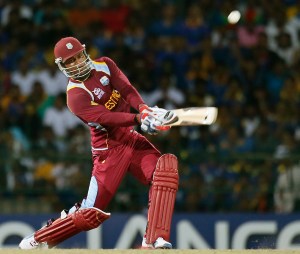
Hitting out...Marlon Samuels blasts his way to a match winning 78 in the World T20 final.
Hitting out…Marlon Samuels blasts his way to a match winning 78 in the World T20 final.

After two decades of heartbreak the West Indies finally seemed back on the right track as they claimed their first World Cup victory in 33 years. Going into the tournament as many people’s favourites, the Windies overcame many obstacles to seal a 36-run final victory over hosts Sri Lanka in Colombo. Marlon Samuels was the star of the show, blasting 78 of 56 balls to leave his side with 137 runs off their 20 overs after they had found themselves on just 32-2 at the half way point in their innings. 137 never looked another to defend against an experienced Sri Lankan batting line up but a combination of good bowling and panic in the hosts batting cost them dear and they were eventually bowled out for just 101, sparking wild celebrations and Gang’nam Style dancing from the West Indian players.


County Cricket:

Warwickshire won the LV = County Championship for the first time since 2004, as they finished 32-points ahead of second placed Middlesex. For the Bears, key contributions came from fast-bowler Chris Wright (67 wickets) and opening batsman Varun Chopra (1052 runs).

Elsewhere Hampshire won the Friends Life T20 beating Yorkshire in the final by 10-runs. Setting the White Roses 151 to win, Hampshire, led by rookie bowler Chris Wood, kept their calm to pick up their second title in three years.

The Clydesdale Bank Pro40 final consisted of Championship winners Warwickshire and T20 winners Hampshire and was not a disappointment. After being set 244 for victory by Hampshire, Warwickshire were seemingly in control of the run chase and required just one run from the final ball, only for Kabir Ali to bowl a dot ball to Neil Carter and deny Warwickshire victory via too many wickets lost.

Indian Premier League:

Kolkata Knight Riders won the fifth episode of the IPL after defeating the Chennai Super Kings in an exciting final in Chennai. Set 191 to win the Knight Riders scraped a victory with 5-wickets and just two balls remaining thanks to a 136-run partnership for the second wicket between Jaques Kallis (69) and Manvinder Bisla (89). Kolkata’s Sunil Narine was the tournament’s best player with 24 wickets at 13.50 as well as an economy rate of just 5.47.

Farewell to:

2012 saw the loss of many influential figures in the game, both through death and retirement.

English cricket lost both young and old talents in the game. In June a tragic tube accident claimed the life of Surrey’s Tom Maynard. Maynard was just 23-years-old and many claimed he was a future England star in the making, his life was one cut far too short.

A fond farewell...Tony Greig 1946-2012
A fond farewell…Tony Greig 1946-2012

As much as Maynard was the future of the English game, Tony Greig played a significant part in its past. As a former England captain and founder of World Series Cricket in the late-70’s, Greig would go on to become one of cricket’s most iconic broadcasters, his voice was heard across the world for the best part of 30 years and his death to a heart attack in late December brought great sadness to everyone.

2012 also saw the end of the careers of a host of the generation’s great batsmen. In March the Indian great Rahul ‘The Wall’ Dravid finally called it quits from international cricket after a career that spanned 164 Test matches and 344 ODI’s.

Like Dravid, VVS Laxman was part of the golden generation of Indian batsmen during the 90’s and 2000’s and it came as a surprise as he ended his career in August before the Test series with New Zealand, he played 134 Test and 86 ODI’s for his county with great success.

Despite claiming the Tour of England would be his last series, no one would have wanted Mark Boucher’s career to end the way it did. Keeping wicket in a tour match before the series began, he was caught in the eye by a bail and lost all sighting in his eye because of it, this forced him into an earlier than expected retirement after 15 years of service to the Proteas, in which he played 147 Test matches and 295 ODI’s. He left the international game with 999 dismissals to his name.

Not since the days of Sir Donald Bradman have Australia produced a batsman with the quality of Ricky Ponting and the modern day great finally announced his retirement in late November after battling a series of poor scores again South Africa. He leaves the game behind having played 168 Test matches (in which he won 108) and 375 ODI’s.


Farewell Ricky, it’s been a privilege

The old saying goes, “all good things have to come to an end.” Ricky Ponting was good, very good, in fact he was a great.

For Ponting the end is nigh. When he walks out at the WACA on Friday morning, it will be his 168th and final Test, a career that has seen him claim 108 Test victories, with 48 of those as captain.

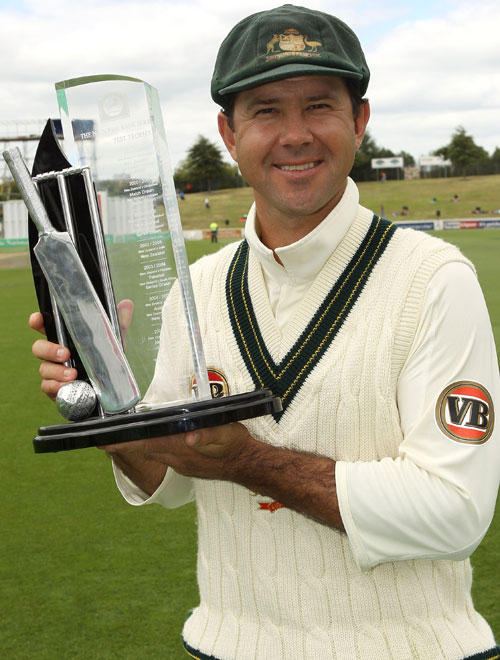
Ponting with one of many trophies he won during an illustrious career.

You can’t help but hope for a fairytale ending for Ponting. How about a hundred in his final match at a ground where it all began for him in 1995 and a victory over South Africa that would lift his side back to number one in the ICC Test Rankings – it would be a fitting end to a glorious career.

After announcing his retirement, Ponting said that he wanted to win his final match more than any other game he has ever played. The drive and determination is still there, but unfortunately for Punter, age has finally caught up with him.

It seemed the Australian selectors were willing to grant Ponting his one last wish and final frontier – an Ashes series on English soil, but in sport things don’t always pan out the way you want them to.

Recently reading a Sidharth Monga article on espncricinfo.com, I picked up on this wonderful quote on Sachin Tendulkar’s ongoing struggles:

“People are struggling to come to terms with his mortality. They want him to retire because they want to live with happier memories. That’s selfish.”

It made me realise that I had thought this about Ponting. As a big fan of his, I wanted him to go on and reclaim the Ashes in England, but I didn’t want him to continue to struggle and look a part of his former self. That Jacques Kallis ball that dismissed him in Adelaide wasn’t what I wanted to remember him by, but instead the slight of him bringing up another Test century with a crisp drive through the covers.

We all have to realise that our favourite players can’t go on to play at their best forever, there has to be a time when we have to respect the timing of a players retirement, after all only the player himself knows, when to make that difficult call.

For all of this I think Ponting picked the right time to hang up his bat and depart from the game. He has been in inconsistent form over the past 18 months, but if it wasn’t for his mental input on the side and his determination to work hard, then Michael Clarke’s men wouldn’t be vying for the Test mace right now.

The best since Bradman?

Although Clarke has led the side through their rebuilding process, he has still relied heavily on the likes of Ponting and Mike Hussey as his go to men. There is no way Australia could have let Ponting and Hussey depart from the side after the retirements of key players such as Shane Warne, Adam Gilchrist, Glenn McGrath, Matthew Hayden, Justin Langer and to a lesser extent Brett Lee and Simon Katich – all in the past six years.

Ponting is a once in a generation player, only Greg Chappell can rival him as Australia’s best batsman since Sir Donald Bradman, players like this don’t come around very often. For over a decade Ponting was the best batsman in the world’s best team.

His stats are overshadowed by no Australian bar Bradman. His 13,366 runs are more than any of his compatriots ever managed as are his 41 Test hundreds and his final Test appearance at Perth will equal Steve Waugh’s haul of 168.

In ODI cricket his three World Cup victories – with two as captain stand out, as does his 30 ODI centuries.

So after 17 years of service to the Baggy Green, it’s time to say farewell Punter, I hope you do a Steve Waugh and bow out the way we all want you to with your side back on top of the world, but if not we will remember the stroke play, dedication and passion that you brought to Cricket Australia during its most successful period.

Captaincy inspires Pup’s love for big runs

Michael Clarke’s unbeaten 259 in the first Vodafone Test against South Africa again proved his ongoing worth as both Australia’s captain and premier batsman.

Since taking over the Test captaincy from Ricky Ponting nineteen months and fifteen Tests ago, Clarke has scored 1618 runs at 64.72. So far in 2012 he has scored 1041 runs in seven Tests, at a remarkable average of 115.66.

The responsibility of captaincy has certainly brought out the best in Clarke. In 2012 nobody has scored more Test runs than Pup. Along with his 259 against the Proteas and his scores of 329no and 210 against India earlier in the year, he becomes only the third player behind Ponting and Don Bradman to score three scores of over 200 in a calendar year.

In fifteen Tests as captain Clarke has scored 1618 runs at 64.72.

His conversion rate of fifties into hundreds is also an impressive one, of his 42 Test scores of over 50, 20 have been turned into hundreds.

It’s also no coincidence that four of Clarke’s seven Test scores of over 150 have come since he took over the captaincy. He now understands the needs of the team more. With Australia’s current weak middle order, it’s up to Clarke to make the most of his starts and go on to score the big runs.

While Clarke’s batting stats speak for themselves, it’s his positive captaincy that is finally winning around his critics and haters.

Since he took over the job they call the second most important in Australian society (the first being the Australian prime minister) he has led his side to nine wins, four draws and just two defeats. This was meant to be a side in transition; under Clarke they haven’t lost a series.

His captaincy has been as refreshing as it has been successful. He’s a gambler, where as Ponting was a percentage captain, Pup makes his decisions on instinct, unsurprisingly there are hints of Shane Warne in his captaincy, together they share the ability to read the game and give their side the best possible chance of victory.

The 31-year-old has always shown a willingness to learn more about the game, be it from his mentor Ponting or his great friend Warne. As a batsman, a tactician and occasionally a bowler, he is always looking to keep the game moving, always looking for opportunities for runs or wickets and always pushing his team towards greater success.

Things haven’t always been easy for Clarke despite his dream entry to Test cricket in 2004. A debut innings of 151 in India was followed by 141 in his fifth match against New Zealand. The blonde bombshell from New South Wales had arrived into one of the best sides in the history of the game and things couldn’t have begun any better for him.

Things quickly changed for Clarke though, as he was dropped from the side just a year after his debut. Although he would later return after missing only seven Tests, his place in the side was not longer guaranteed.

Clarke worked hard on his game and was soon a regular in the side again making the number five spot his own, but for a time he wasn’t always the most popular player amongst both players and fans alike.

Clarke’s mental strength has become a key part of his captaincy

It was easy to look at Clarke and see the tattoos and the metro sexual image and choose not to see the dedication he brought to him game. There was a time when he was viewed even by some of his teammates as a bit of a glory boy. Richly talented and with an impeccable pedigree, this kid was along for the ride – the only 20-something in a team of hardnosed 30-somethings who ruled the world.

At times the Australian media portrayed the views of many in the public, one journalist once wrote: “His problem is a little more delicate. Michael Clarke is a tosser. Or, to give him an out cause, he appears to be a tosser.”

Over the years he has not only found it hard to earn the respect of the Australian public, but of his teammates too. In 2009 after a Test victory in Sydney, Simon Katich grabbed the then vice-captain Clarke by the throat after an argument over when the team song would be sung, Clarke had requested to leave early to attend a meal with his then fiancée Lara Bingle.

Despite all of this no one can ever question Clarke’s mental strength. In early 2008 he spent two months away from the game, firstly attending to his ailing father and then helping Bingle deal with the death of her own father, upon his return to the side he scored a fluent 110 against the West Indies in Antigua. Two years later he again showed his ability to deal with personal issues in the middle when he scored a first innings 168 in New Zealand, just a week after his well publicised split-up with Bingle.

That mental strength has since served Clarke well, the consistency of his batting has improved so much so that he is now ranked amongst the best batsmen in the world, his captaincy is fresh and exciting and his popularity is finally on the rise, the once unloved pup is now Australia’s top dog.

The Gayle v Watson show

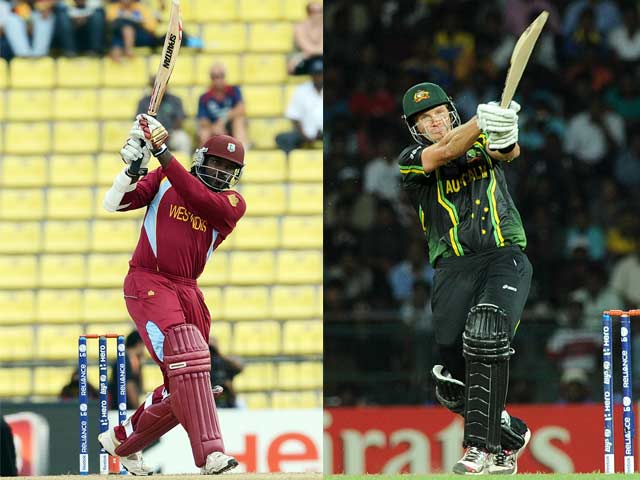
When Australia and the West Indies meet on Friday for their semi-final encounter, all eyes will be firmly on two players, Chris Gayle and Shane Watson.

The story of the tournament for each side has been – lose your boundary biffing beast early, and struggle thereafter. Gayle and Watson are those beastly figures, irreplaceable forces in the shortest form of the game and match winners on their day. To put it bluntly, they put bums on seats.

“The Gayle v Watson showdown” – Coming to Colombo this Friday.

So reliant on their star bashers have Australia and West Indies been this tournament, that when they have failed with the bat, their middle orders have looked suspect and under cooked.

After four man-of-the-match awards in a row for Watson, his first failure with the bat coincided with Australia’s first defeat of the tournament, as he made just 8 during his side’s 32-run loss to Pakistan.

Those four man-of-the-match awards were achieved with scores of: 51, 41no, 72 and 70 as well as bowling figures of: 3/26, 2/29, 3/34 and 2/29.

Gayle too, has similarly had to carry the West Indian hopes of a large total on his broad shoulders. His one real failure with the bat came in their biggest defeat of the tournament, a 9-wicket defeat to Sri Lanka, in which he scored just 2.

His dominance with the bat hasn’t quite reached Watson levels, but scores of: 54, 58 and 30 have been vital in winning causes for the West Indies.

The biggest difference between Gayle, Watson and the rest has been the speed in which they have scored their runs. In his four innings this tournament Gayle has scored 144 runs at a strike rate of 158.24, while Watson has 242 runs at 154.14 in his five innings.

Gayle will look to hit Pat Cummins, Mitchell Starc and co from ball one – long, straight and far, bowl too straight at your peril. The big Jamaican favours hitting in the V, perhaps his favourite shots of them all are; the effortless six over long off or the carve through the covers off both front and back foot, Australian bowlers beware.

Standout performer…Shane Watson has claimed four man-of-the-match awards in five matches.

Watson, like Gayle, loves nothing more than smashing the ball into the bleachers. He thrives on anything short or even back of a length. Always quickly into position, his pull shots have been a joy to behold in this tournament, as both pace and spin has been deposited to the fence with minimum fuss, this is the way Watson bats.

His 70 against South Africa was particularly impressive, after losing partner David Warner early, Watto played out hostile spells from both Dale Steyn and Morne Morkel before taking the attack to the spinners.

If Watson outlasts the opening spells of Ravi Rampaul and Samuel Badree, then Sunil Narine will have to be at his very best or Watson could take the game away from an average West Indies bowling attack.

Gayle will look to do likewise. With the West Indies middle order currently being as unpredictable as the Sri Lankan monsoon season weather, it will be up to Gayle to go big and long. If he is there past the fifteenth over, then 200 would not be out of reach for the Windies.

This time tomorrow we will know who will play Sri Lanka in the World T20 final on Sunday, the questions remain though: will it be Chris’ West Indies or Shane’s Australia? Will either of the opening destroyers go big and pull out a match winning performance? Will both decide on a personal “boundary hitting duel.” The Gayle verses Watson show – has a ring to it, doesn’t it.

Should either perform to their very best, then there will be two winners tomorrow and cricket will be one of them.

What next for Ravi?

After his dropping by England for their T20I at Old Trafford on Monday evening, I ask – what is next for Ravi Bopara’s international career?

The stocky right-hander has failed miserably in recent times, scoring just 28 runs in his last five international innings, surely not the returns of a man worthy of the England number three position.

After pulling out of the England squad for the second Test with South Africa at Leeds for personal reasons, his scores (for Essex and England) have read: 0, 1, 3, 2, 16, 0, 6, 0 and 6. Such scores suggest Bopara isn’t mentally right for the game right now.

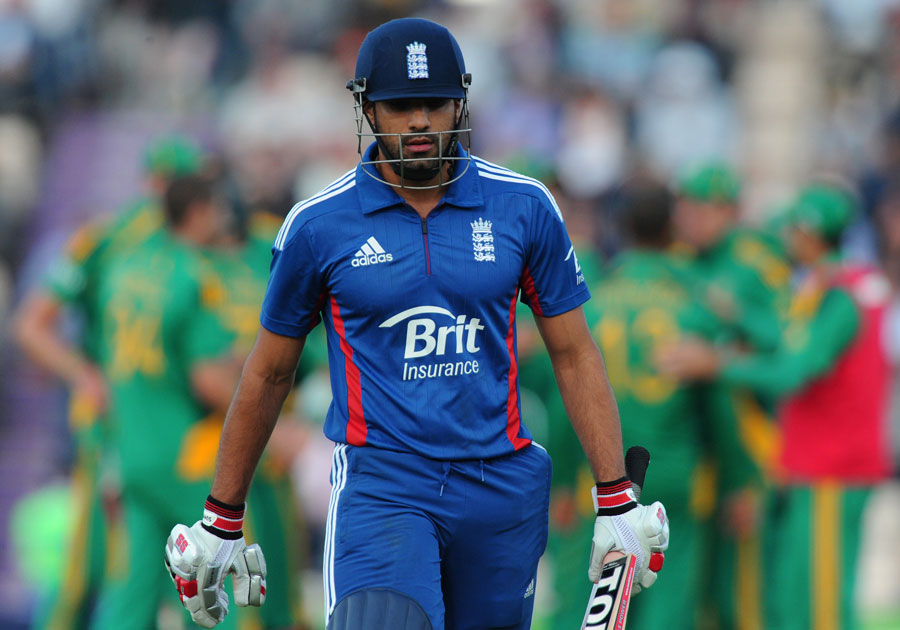
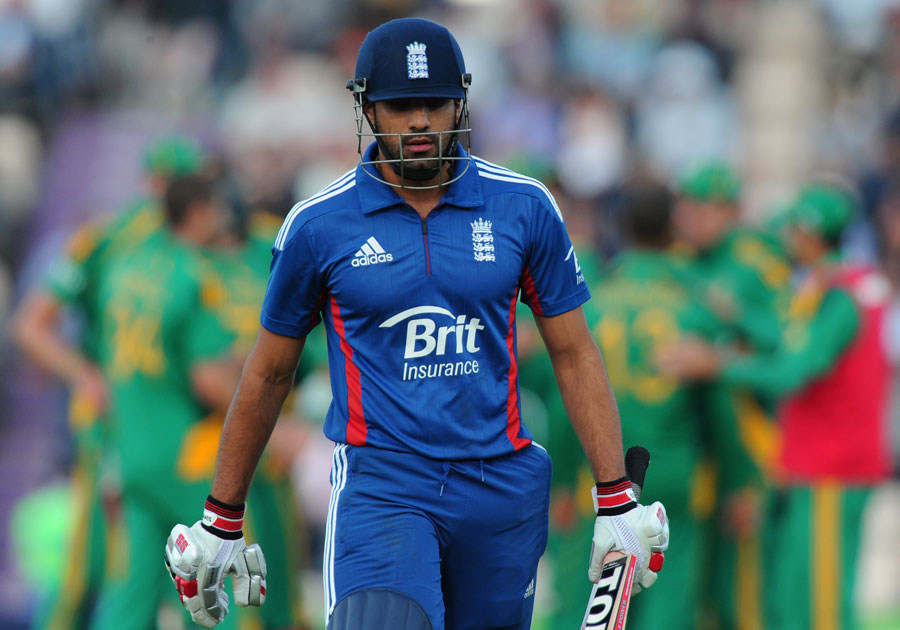
Bopara walks back after another ODI failure

This is where England’s conundrum comes into it, what do they now do with Bopara?

After being replaced by Luke Wright at number three for the recent T20I match in Manchester, it appears unlikely that Bopara will now regain his place for the ICC T20 World Cup in Sri Lanka later this month.

Surely England can’t carry a batsman struggling to hit the ball off the square, for such an important tournament, they are after all defending champions. The 15-man squad cannot now be changed unless of an injury, so Bopara will have to go as one of the reserve batsmen.

Back in June things were finally looking up for Bopara, a man whose international career seems to have stalled more times than a learner driver.

After missing England’s winter Test series in Sri Lanka due to a side strain, he was due to play the Test series against the West Indies in May, but again injury (this time a thigh problem) put pay to his chances, leaving Jonny Bairstow to instead debut in his place.

Bopara didn’t let the two setbacks deter him though, he went back to Essex to regain his fitness and form and with it, his place in the England ODI side.

His returns in two ODIs against the West Indies and four against Australia were: 8, 19no, 15, 82, 33no and 52no as England won all six. Ravi was back and raring for another go at Test cricket.

That’s when the disappointments started again. Picked to bat at number six against the might of South Africa in the first Test at The Oval, he scored only 0 and 22 as England were well beaten.

Due to play for Essex in a Pro40 match in between Test matches, he pulled out stating personal issues and immediately informed the ECB he would be unavailable for selection for the Headingley Test match.

It’s not our right to speculate on what the problem in Bopara’s personal life is, but his form (since pulling out of the England squad) has been none existent, this too after withdrawing from the England Lion’s squad on the morning of their match with Australia A on August 7th.

Surprisingly though as his batting has suffered his bowling has not. Often a bowler who is quicker than most think, his economy rate in recent ODI’s has been excellent. Whilst bowling in the recent South Africa ODI series he had economy rates of 3.10, 3.77, 3.00 and 4.00, perhaps he feels less pressure in bowling than batting – the discipline he has earned his reputation for.

An average of 31 – suggests Bopara’s Test career has failed to take off

Always a man who has shone on the domestic circuit, Bopara must again feel his international career slipping out of his grasp, and not for the first time.

Since making his Test debut against Sri Lanka in December 2007, he has played in only 13 of England’s 62 Test matches since – a damning statistic alone, this highlights his inconsistent form and fitness over the past four and a half years.

His numbers don’t lie either. His 13 Tests matches have brought him 575 runs at just 31.94 – this in an era where top order batsmen shouldn’t be averaging much under 40.

The fact that his first-class average is 41.99, ten more than his Test average also tells a tail of its own, perhaps Bopara is never destine to be the great international cricketer his talent once suggested. These things happen – remember Graeme Hick or Mark Ramprakash, great in County cricket, but a disappointment on the biggest stage.

At 27, Bopara still has time to rectify this, but with England’s Test squad for their series in India this November due to be announced on Thursday, I don’t expect to see Ravi’s name on the list.

Despite the fact that the Kevin Pietersen debacle is still ongoing, Bopara is likely to remain down the picking order or the cab rank as the England selectors like to call it these days – with Bairstow, James Taylor and Nick Compton the more likely middle order candidates.

With no more ODI cricket scheduled for the rest of the year, it appears Bopara won’t again play for England until at least 2013, the best he can now appear to hope for is a place on the Lion’s tour of India in December – Until then his only opportunity seems to be by seizing on the misfortune of an injured teammate at the T20 World Cup.